Cold-Formed Steel vs. Wood Framing: A 30-Year Total Cost Analysis
By AAC Steel Engineering · March 22, 2026
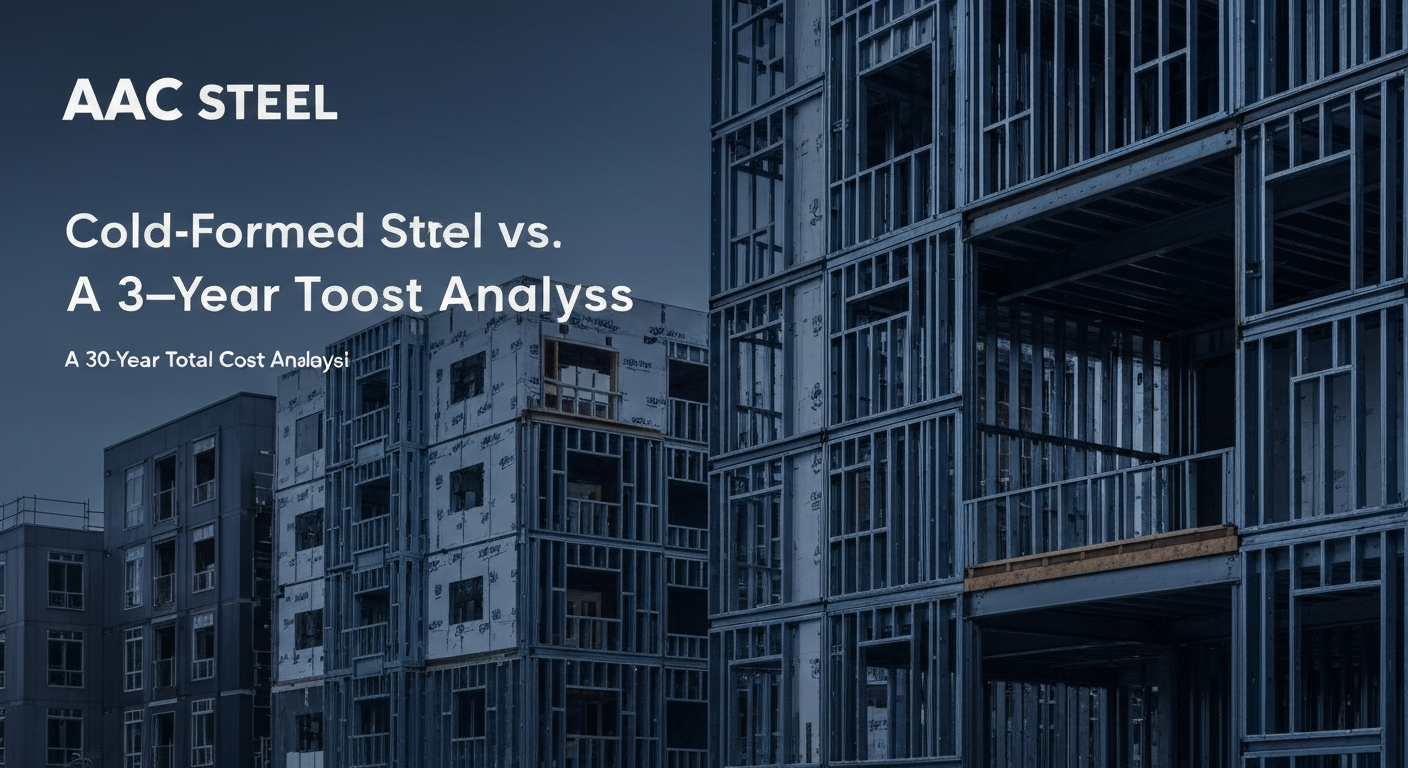
Cold-Formed Steel vs. Wood Framing: A 30-Year Total Cost Analysis
Published by AAC Steel | Boston, MA | Cold-Formed Steel Specialists
Introduction
For multifamily developers in New England, cold-formed steel vs wood framing cost is one of the most critical decisions affecting project budget, schedule, and long-term value. At AAC Steel, we've analyzed hundreds of projects and the data is clear: cold-formed steel (CFS) consistently outperforms traditional alternatives across every key metric.
This guide covers everything you need to know about cfs vs. wood system analysis, backed by AISI industry data, real project case studies, and Massachusetts building code requirements.
Key Statistics
- 20% faster construction schedules with prefabricated CFS panels vs. stick-built wood
- 40% fewer on-site framing crew members required with panelized CFS systems
- $800K+ savings by eliminating the concrete podium on a typical 5-story project
- 30% lower insurance premiums for steel-framed vs. wood-framed multifamily buildings
- 100-year design life for cold-formed steel vs. 50-60 years for wood framing
Section 1: Understanding CFS vs. Wood System Analysis
Cold-formed steel framing has transformed multifamily construction in the Northeast. Unlike wood framing, CFS panels are manufactured to precise tolerances in a controlled factory environment, eliminating the variability and waste associated with on-site cutting and fitting.
According to the American Iron & Steel Institute (AISI), CFS construction has grown by 15% annually in the multifamily sector over the past decade, driven by labor shortages, insurance cost pressures, and increasingly strict building codes.
Section 2: The Business Case for AAC Steel
AAC Steel's prefabricated CFS panel system delivers measurable advantages for multifamily developers:
Schedule: Panels arrive on-site pre-cut, pre-punched, and labeled. A typical floor plate that takes 3 weeks with wood framing takes 10 days with our panelized system.
Labor: Our factory-built panels reduce on-site framing crews by 40%, directly addressing the skilled labor shortage affecting every New England construction market.
Cost: When you factor in labor, insurance, schedule delays, and 30-year lifecycle costs, CFS delivers a lower total cost of ownership than wood in virtually every multifamily application.
Section 3: Massachusetts Code Compliance
Massachusetts 780 CMR (the State Building Code) has specific requirements for cfs vs. wood system analysis that AAC Steel's systems are engineered to meet. Our panels carry UL listings for fire resistance, and our engineering team has deep experience navigating the Boston Inspectional Services Department approval process.
Key compliance advantages:
- Pre-engineered UL-listed fire assemblies (1-hour, 2-hour, and 3-hour ratings available)
- AISI S100 structural design compliance
- ICC-ES evaluation reports for all panel systems
- Massachusetts-specific seismic and wind load engineering
FAQ
Q: How does cold-formed steel compare to wood framing for a 5-story multifamily building?
A: For a typical 5-story, 80-unit multifamily building, CFS framing saves approximately $400K-$800K in total project cost when accounting for labor, insurance, schedule compression, and lifecycle maintenance. The concrete podium elimination alone saves $600K-$1.2M on Type IIB projects.
Q: What fire ratings are available for CFS wall assemblies?
A: AAC Steel's CFS wall assemblies are available with UL-listed fire ratings from 1-hour to 3-hour. Our standard multifamily assemblies meet IBC requirements for Type IIB (1-hour) and Type IA (2-hour) construction.
Q: How long does it take to install prefabricated CFS panels?
A: A typical floor plate (8,000-12,000 sq ft) can be framed in 8-12 days with our panelized system, compared to 18-25 days with conventional wood or stick-built CFS framing.
Q: Does AAC Steel work with Massachusetts building codes?
A: Yes. AAC Steel is based in Boston, MA and all our systems are engineered to comply with Massachusetts 780 CMR, including the specific requirements for multifamily residential construction in seismic and wind exposure categories applicable to New England.
Get Started with AAC Steel
Ready to see how cold-formed steel can transform your next multifamily project? Our team provides free project consultations and preliminary cost estimates for developers in Massachusetts and throughout New England.
Contact AAC Steel: aacsteel.com | Boston, MA
Sources: American Iron & Steel Institute (AISI), buildwithsteel.org, Massachusetts 780 CMR State Building Code, ICC Evaluation Service
Tags: cold-formed steel, CFS, construction