How Cold-Formed Steel Framing Eliminates Podium Construction in 5-Story Multifamily Buildings
By Carlos Ferreira · April 13, 2026
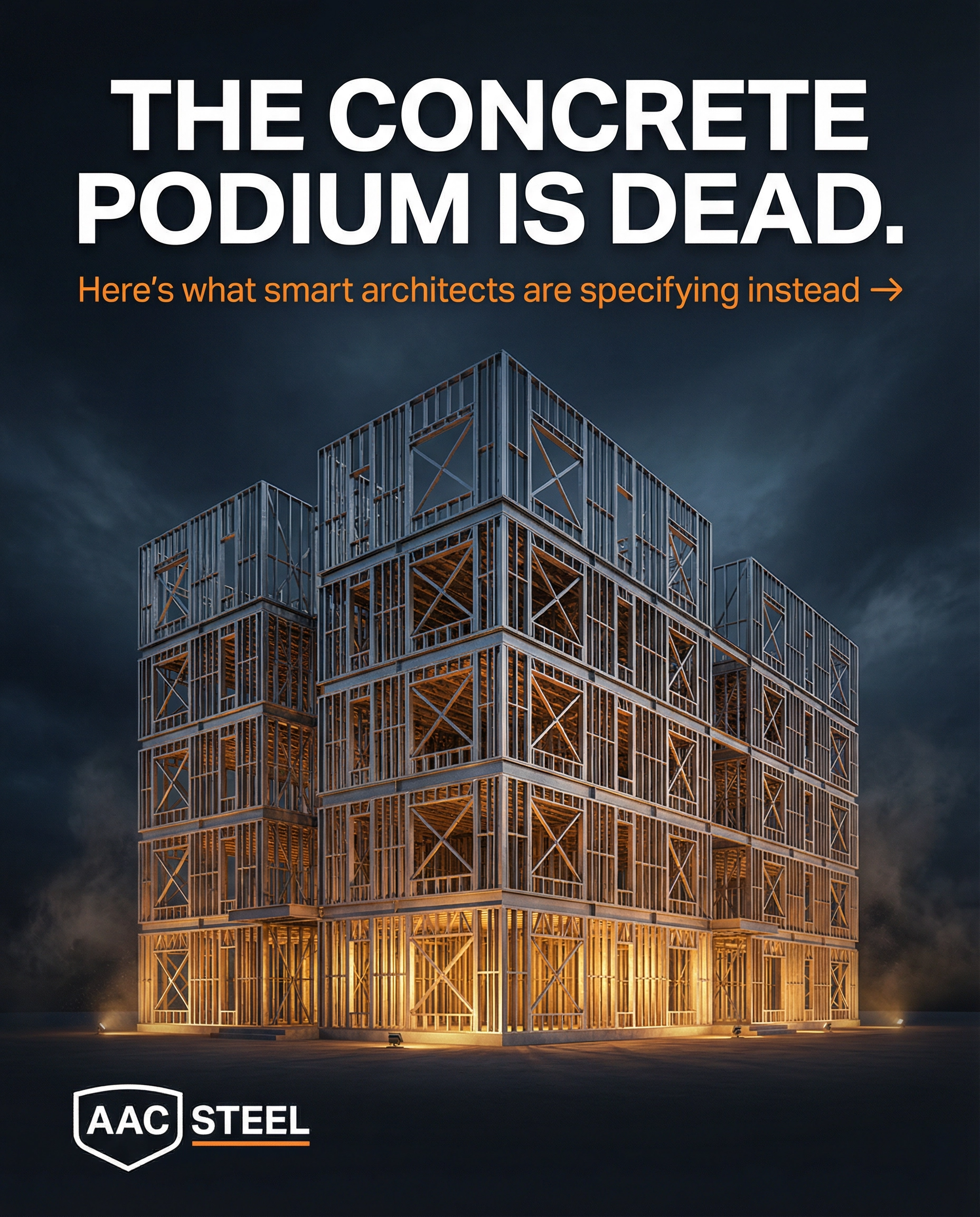
How Cold-Formed Steel Framing Eliminates Podium Construction in 5-Story Multifamily Buildings
Executive Summary
For mid-rise multifamily developers, the traditional path to five-story residential construction follows a well-worn formula: one story of expensive Type IA reinforced concrete podium supporting four stories of Type VA wood-frame construction above. This "4-over-1" model is deeply embedded in the development community's cost assumptions, pro forma templates, and contractor bid schedules. It is also increasingly unnecessary — and in many cases, economically counterproductive.
Cold-formed steel (CFS) framing presents a structurally sound, code-compliant alternative that eliminates the concrete podium entirely. Under International Building Code (IBC) 2021 Type IIB construction, a Group R-2 multifamily building equipped with an NFPA 13 sprinkler system may be built to five stories and 75 feet of building height without any requirement for a concrete transfer slab or podium structure. Because cold-formed steel is a non-combustible material, the entire building — from the first floor above grade to the fifth — can be framed uniformly with precision-engineered CFS load-bearing wall panels and floor assemblies.
The financial implications are substantial. A Type IA post-tensioned concrete podium floor on a 20,000 square foot floor plate carries an installed cost of $440,000 to $700,000 or more — before the first wood stud is set above it. Eliminating that line item, while simultaneously delivering a non-combustible building with lower insurance premiums, reduced fire risk, and factory-precision panel fabrication, reframes the economics of five-story development entirely.
This technical report provides a code-accurate, cost-quantified analysis of CFS podium elimination: the IBC code basis governing construction type selection, a comparative cost framework, the structural engineering principles that make load-bearing CFS viable at five stories, and the AAC Steel panelized fabrication and delivery process that converts these code allowances into an executable construction methodology.
The Podium Problem: Why 5-Story Wood Construction Requires a Concrete Transfer Slab
To understand why cold-formed steel eliminates the podium, it is necessary to first understand why wood framing requires one. The answer lies in the fundamental structure of the International Building Code's construction type classification system.
IBC Construction Types and the Combustibility Barrier
The IBC organizes all construction into five types — IA, IB, IIA, IIB, III, IV, and V — based on the fire-resistance rating of structural elements and the combustibility of those elements. The two noncombustible categories (Types I and II) allow greater building heights and larger floor areas than the combustible categories (Types III, IV, and V), because noncombustible structural systems inherently limit fire spread and structural collapse risk.
Wood framing — dimensional lumber, engineered lumber, and structural panels — is a combustible material under IBC definitions. Accordingly, wood-framed construction is limited to Types IIIA, IIIB, VA, and VB, which carry the most restrictive height and area limitations in the IBC. For Group R-2 occupancy (multifamily residential) with NFPA 13 sprinklers, Type VA wood construction is limited to four stories under IBC 2021 Table 504.4.
That four-story ceiling is the source of the podium. Developers seeking five-story buildings — the floor-count sweet spot for New England multifamily economics — cannot achieve it with wood framing alone. The workaround is the "4-over-1" model: a one-story Type IA reinforced concrete podium (non-combustible, with inherent 3-hour fire-resistance ratings) serves as a transfer level and occupancy separator, above which four stories of Type VA wood framing are stacked. The concrete podium resets the height count, allowing the wood stories above to be counted from the podium slab rather than from grade.
What a Concrete Podium Actually Costs
The podium floor is a complex structural system in its own right. It must carry the full dead and live loads of four stories of wood framing above, transfer those loads to the columns and shear walls below, provide the rated floor/ceiling separation required between the Type IA podium and the Type VA occupancy above, and meet the waterproofing requirements if the podium deck also serves as a roof over parking or amenity spaces.
Typical Type IA podium floor construction involves:
- Post-tensioned concrete deck: 8-to-10-inch two-way flat plate or flat slab, typically post-tensioned to control deflection and crack width under service loads, with ordinary mild-steel reinforcement at penetrations and slab edges
- Concrete shear walls and columns below: The podium level requires a complete lateral force-resisting system, typically cast-in-place reinforced concrete shear walls and gravity columns with transfer capabilities for the wood shear wall loads coming from above
- Foundation implications: The concentrated column and shear wall reactions from podium construction typically require either a mat foundation or heavily-reinforced spread footings — significantly more robust (and expensive) than the continuous strip or spread footings adequate for a uniform CFS building
- Sequencing and schedule impacts: Concrete placement, curing (28 days to design strength), post-tensioning stressing, waterproofing, and podium slab inspection consume 4–8 weeks of schedule before framing above can begin
The installed cost of a Type IA post-tensioned podium floor runs $22–$35 per square foot under current RSMeans 2024 data, excluding the premium foundation work below. On a 20,000 square foot typical mid-rise floor plate, that represents a single-line-item cost of $440,000 to $700,000. For a 150-unit building, the podium adds $2,933 to $4,667 per residential unit in direct construction cost — before accounting for the foundation premium, the schedule extension, or the added general conditions overhead during concrete curing.
| Cost Component | Unit Cost Range | Total Cost (20,000 SF) |
|---|---|---|
| Post-tensioned concrete deck (10" slab) | $14–$20/SF | $280,000 – $400,000 |
| Mild steel reinforcing & PT tendons | $4–$7/SF | $80,000 – $140,000 |
| Formwork, shoring, reshoring | $5–$9/SF | $100,000 – $180,000 |
| Concrete columns and shear walls (podium level) | Lump Sum | $80,000 – $140,000 |
| Foundation premium (concentrated loads) | Lump Sum | $40,000 – $80,000 |
| Waterproofing / deck coating (if over parking) | $3–$6/SF | $60,000 – $120,000 |
| Total Podium Cost (Installed) | $27–$46/SF effective | $540,000 – $920,000 |
| Schedule Impact (Framing Delay) | 4–8 weeks | Financing carry at 7.5% = $85,000–$170,000 per month |
These numbers underscore a critical point: the concrete podium is not a minor line item. It is a structural subsystem carrying cost and schedule implications that compound throughout the project. Eliminating it is not a marginal improvement — it is a fundamental reconfiguration of project economics.
The Code Basis for CFS Podium Elimination: IBC 2021 Type IIB Construction
The mechanism by which cold-formed steel eliminates the podium is straightforward: CFS is a noncombustible material, and noncombustible materials qualify for IBC Type II construction, which is permitted at five stories for Group R-2 occupancy without any requirement for a podium structure or occupancy separation.
Cold-Formed Steel as a Noncombustible Material
IBC 2021 Section 202 defines noncombustible material as one that passes the test requirements of ASTM E136, Standard Test Method for Combustibility of Construction Materials. Cold-formed steel — thin-gauge steel sheet formed to structural shapes at ambient temperature — is inherently noncombustible. It does not ignite, does not contribute fuel to a fire, and does not produce combustion products. Steel's melting point exceeds 2,700°F; wood ignites at approximately 400–500°F.
Because CFS meets the noncombustible definition, CFS-framed buildings may be classified under IBC Types IA, IB, IIA, or IIB. This classification is the key that unlocks five-story construction without a podium.
IBC 2021 Tables 504.3 and 504.4: Height and Story Limits by Construction Type
IBC 2021 Tables 504.3 (maximum building height in feet) and 504.4 (maximum number of stories above grade plane) define the allowable building envelope for each occupancy group and construction type combination, with separate columns for sprinklered and non-sprinklered conditions.
For Group R-2 (multifamily residential) with a full NFPA 13 fire suppression system, the applicable limits are:
| Construction Type | Maximum Stories (Table 504.4) | Maximum Height in Feet (Table 504.3) | CFS Eligible? | Notes |
|---|---|---|---|---|
| Type IA | Unlimited | Unlimited | Yes | Requires 3-hr structural frame; used for high-rise CFS |
| Type IB | 12 | 180 ft | Yes | 2-hr primary structural frame; efficient CFS mid-high-rise path |
| Type IIA | 5 | 85 ft | Yes | 1-hr structural frame; 10 ft of additional height vs. IIB |
| Type IIB | 5 | 75 ft | Yes | 0-hr structural frame; no podium required; most efficient for 5-story |
| Type IIIA | 5 | 65 ft | No (primary frame) | Combustible exterior walls permitted; CFS not primary structure |
| Type VA | 4 | 60 ft | No | Wood framing — podium required to reach 5 stories |
The key insight from Table 2 is that Type IIB CFS construction achieves exactly five stories — the target story count for the majority of mid-rise New England multifamily projects — without any podium, without any fire-resistance rating requirement on the primary structural frame, and without the concrete transfer system that defines the 4-over-1 model. The five-story CFS building is structurally uniform from foundation to roof.
The Role of NFPA 13 Sprinklers in Achieving Five Stories
IBC 2021 Section 903.3.1.1 mandates NFPA 13 sprinkler systems in all Group R-2 occupancies in buildings four or more stories in height. Far from being an added cost, this requirement is also the mechanism by which the IBC grants generous height and story increases over the unsprinklered baseline. Tables 504.3 and 504.4 include two columns — one for unsprinklered buildings and one for buildings equipped with NFPA 13 systems — and the sprinklered allowances are substantially higher.
For Type IIB construction, NFPA 13 sprinklers elevate the Group R-2 maximum from three stories to five stories — a 67% increase in permissible building height, triggered by a sprinkler system that is already code-required at this building scale. Developers who account for the sprinkler premium in their pro formas should also account for the height benefit it buys: at Type IIB, each sprinklered story above three stories is, in effect, a "free" story relative to the unsprinklered baseline.
IBC Section 510 Bonus Pathways: Pushing Beyond Five Stories with CFS
For developers whose programs require more than five stories, IBC 2021 Section 510 provides several additional pathways using CFS as the structural system:
- IBC §510.2 — Single Podium: A one-story Type IA podium with a 3-hour floor/ceiling assembly separating it from the residential occupancy above permits up to five stories of Type IIB CFS above the podium, for a total of six stories above grade. This is the minimum-podium scenario for developers who need one additional story beyond the baseline Type IIB limit.
- IBC §510.4 — Two-Story Podium: A two-story Type IA podium supports up to five stories of Type IIB CFS above, yielding a seven-story total building. This is the configuration commonly seen in podium projects with two levels of structured parking below four or five floors of residential.
- IBC §510.6 — Large Lot Bonus: For qualifying Type IIA buildings on lots meeting specific area requirements, an additional story is permitted. This pathway is site-dependent and less frequently applicable in dense urban markets, but available for suburban New England garden-style projects on larger parcels.
Massachusetts-Specific Note (780 CMR): Massachusetts building code (780 CMR, 10th Edition) imposes a high-rise threshold at 70 feet of building height, measured from grade plane to building height per Massachusetts-specific definitions — a more restrictive standard than the IBC's 75-foot Type IIB maximum. Projects approaching 70 feet require careful Massachusetts-specific analysis. For buildings between 70 and 75 feet under IBC, the Massachusetts threshold triggers high-rise provisions including additional egress, emergency power, and fire protection requirements not imposed by the baseline IBC. This 5-foot difference has significant implications for floor-to-floor height selection in Massachusetts Type IIB CFS projects.
Structural Engineering: Why Cold-Formed Steel Can Carry Five Stories
The engineering principle that enables podium elimination is the continuous load-bearing capacity of the CFS structural system from roof to foundation slab. Unlike a 4-over-1 building — where wood shear walls and gravity posts must transfer all loads through a concrete diaphragm to a completely different structural system below — a Type IIB CFS building maintains a single, coherent structural system throughout its full height.
Strength-to-Weight Ratio and Axial Load Capacity
Cold-formed steel has the highest strength-to-weight ratio of any mainstream construction material. ASTM A1003 SS Grade 33 steel — the minimum grade used for CFS structural members per AISI S240-20 — has a minimum yield strength of 33 ksi. Higher-strength grades (SS Grade 50, Grade 55) are increasingly standard in load-bearing CFS studs, with yield strengths up to 55 ksi available from major coil producers.
In practical terms, this means a 600S162-54 CFS stud (6-inch depth, 1-5/8" flange, 54 mil / 16 gauge, Grade 50) can carry axial loads of 8,000 to 14,000 pounds per stud depending on unbraced length, end conditions, and buckling mode, per AISI S100-16 Direct Strength Method or Effective Width Method calculations. At 24 inches on center in a typical load-bearing wall, this produces wall-panel capacities of 4 to 7 kips per linear foot of wall — more than sufficient for five stories of residential gravity loading.
Continuous Load Path Design: Floor to Foundation
The defining structural feature of a successful 5-story CFS building is a fully coordinated, continuous vertical load path. This requires that CFS bearing studs align vertically at each floor level — a requirement that demands close coordination between the architectural floor plan and the structural framing layout from project inception.
AAC Steel's engineering workflow begins with a load path analysis at schematic design, identifying load-bearing wall locations and confirming stud alignment from floor-to-floor. Gravity loads from the fifth-floor roof assembly transfer to fifth-floor wall studs, then through the floor assembly to fourth-floor studs, and continue in sequence to the foundation. Lateral loads (wind per ASCE 7-22 MWFRS, seismic per ASCE 7-22 and AISI S400-20 CFS-SFRS provisions) are carried by the designated CFS shear walls down to the foundation anchor system.
Key structural design elements per AISI S240-20 (North American Standard for Cold-Formed Steel Structural Framing) include:
- Track-to-stud bearing connections: Clip angle or bridging connections to transfer axial loads between floors without eccentricity
- Web crippling at bearing points: Verified per AISI S100-16 Section C3.4 at all floor beam bearing locations, with bearing stiffeners specified where required
- Rim board and rim track design: Engineered to transfer floor diaphragm forces to shear walls and carry the combined gravity and lateral reactions at floor-wall intersections
- Hold-down system: Rod-and-coupler continuous hold-down assemblies from the foundation up through the full building height, sized for cumulative overturning from lateral loads over five stories
- Floor assembly deflection limits: L/480 for floor assemblies under live load per AISI S240-20 and AISC criteria, verified to avoid cracking of finish materials and ensure serviceability
Fire-Resistance Requirements for Type IIB
One of the most commercially significant aspects of Type IIB construction is the fire-resistance rating requirement for the primary structural frame: zero hours. IBC Table 601 specifies 0-hour fire-resistance ratings for Type IIB columns, beams, and bearing walls. This does not mean that fire-rated assemblies are absent from the building — floor/ceiling assemblies separating occupancies, shaft walls, and dwelling unit separation walls all carry rating requirements from IBC Table 508.4, NFPA 13, and IBC Chapter 7. But the structural framing itself does not require tested fire-resistance treatment in Type IIB.
This is a meaningful cost difference from Type IIA (1-hour structural frame) and Type IB (2-hour), where structural members require either intumescent coating, spray-applied fire-resistive material (SFRM), or tested UL assembly protection. In Type IIB, the structural CFS members are installed without fireproofing, dramatically simplifying coordination and reducing material and labor costs.
Where fire ratings are required — dwelling unit separations per IBC Section 420, corridor walls, and shaft enclosures — UL-listed CFS assemblies provide tested solutions:
| UL Design Number | Assembly Type | Rating | Application |
|---|---|---|---|
| UL G602 | Floor/Ceiling — USG STRUCTO-CRETE over CFS joists | 3-hour ASTM E119 | High-performance floor separation; eliminates concrete topping |
| UL G557 | Floor/Ceiling — CFS joists with gypsum board | 2-hour ASTM E119 | Dwelling unit floor separation (1-hour required, 2-hr typical) |
| UL L501 | Floor/Ceiling — CFS joists with gypsum board | 1-hour ASTM E119 | Corridor and common area floor/ceiling |
| UL U305 | Non-loadbearing CFS partition wall | 1-hour ASTM E119 | Corridor walls, interior partitions |
| UL L541 | CFS floor/ceiling with gypsum | 2-hour ASTM E119 | Dwelling unit separation (above unit-below unit) |
| UL D902 | Protected steel column/beam | 2-hour ASTM E119 | For mixed CFS/hot-rolled hybrid frame applications |
Note: UL G602 uses USG STRUCTO-CRETE fiberglass-reinforced cement panels (3/4" nominal, tongue-and-grooved) over CFS C-joists (minimum 18 ga / 43 mil, ASTM A1003 SS, G60 galvanized) with #10 self-drilling screws at 6" o.c. perimeter / 8" o.c. field. This assembly delivers a 3-hour rating without structural steel deck or concrete topping — replacing approximately 50–65 psf of composite floor dead load with 12–18 psf, a decisive structural and cost advantage over composite deck systems.
The AAC Steel Panelized CFS Process: From Design to Erection
Eliminating the concrete podium through IBC Type IIB CFS construction is a code-enabled strategy, but realizing its full economic benefit requires a panelized manufacturing and delivery methodology that converts design intent into field-ready building components. AAC Steel's manufacturing facilities in Franklin, MA and Woonsocket, RI implement a five-stage process that integrates delegated engineering, factory fabrication, quality control, and just-in-time delivery coordination.
Stage 1: Delegated Engineering and 3D Structural Model
AAC Steel's engineering team, working under the oversight of Carlos Ferreira, PE (MA #41423, licensed in MA, CT, RI, NH, ME, and VT), performs delegated structural engineering for the complete CFS framing scope. This includes:
- Member sizing and layout per AISI S100-16 Direct Strength Method, with member verification via industry software
- Shear wall design per AISI S400-20 CFS-SFRS, with holdown and anchor bolt schedules
- Connection design for track-to-stud, bearing, and diaphragm load transfer conditions
- Coordination of UL fire-rated assembly specifications with architectural wall and floor type matrix
- Foundation anchor requirements transmitted to the EOR for incorporation in foundation drawings
All structural calculations are sealed by a licensed PE and provided to the EOR, GC, and building department as part of the delegated design submittal. Shop drawings are typically delivered within three to four weeks of receiving construction documents, enabling framing permitting to run concurrently with foundation work.
Stage 2: Factory Fabrication with HOWICK Machinery
AAC Steel's HOWICK roll-forming and automated panel assembly equipment fabricates CFS wall panels to tolerances of ±1/16" — a precision standard that field stick-framing cannot consistently achieve. Each wall panel is assembled as a complete structural unit: studs, tracks, blocking, and header assemblies are positioned, punched, and fastened in a controlled factory environment, eliminating the field assembly variables that drive framing rework cycles.
Panel fabrication follows the approved shop drawings directly, with a barcode or QR label on each panel identifying its location in the building. This labeling system allows the field crew to erect panels in sequence without referencing structural drawings, reducing installation time and error rate. AAC Steel's Franklin and Woonsocket facilities are currently expanding to 25,000 SF of combined production space with robotic panel assembly capabilities expected to be fully operational by mid-2026 — a capacity expansion that will support large-scale multifamily projects with accelerated fabrication lead times.
Stage 3: Quality Control and Dimensional Verification
Before shipping, each panel undergoes dimensional verification against the shop drawing tolerance matrix. Critical checks include:
- Overall panel length and height within ±1/16"
- Stud spacing within ±1/8" of specified layout
- Header depth and bearing length per design
- Squareness (diagonal dimension differential ≤ 1/8")
- Holdown hardware pre-installed and torqued
- Penetration blocking positioned per MEP coordination drawings
Factory-level quality control at these tolerances eliminates the most common field framing deficiency categories: out-of-plumb walls requiring remediation, inconsistent stud spacing creating inspection failures, and mislocated blocking requiring re-work ahead of drywall.
Stage 4: Just-in-Time Delivery and Erection Sequencing
AAC Steel coordinates panel delivery with the GC's construction schedule to achieve just-in-time delivery: panels arrive on-site as each floor is ready to receive them, minimizing on-site storage area and the risk of panel damage from jobsite traffic or weather exposure. A typical 150-unit, 5-story building requires 3 to 5 truckloads of panels per floor level, delivered in erection sequence.
Erection typically proceeds at 3,000 to 5,000 square feet of framed area per day with an experienced crew of 6 to 8 workers using a single crane — approximately 55 to 72% faster than equivalent stick-framing operations per SFIA field performance data. For a 20,000 SF floor plate, full-floor framing is typically completed in four to six days, compared to 15 to 22 days for conventional stick framing of the same scope.
Stage 5: On-Site Technical Supervision
AAC Steel provides on-site technical supervision during the erection of the first floor to verify anchor bolt engagement, holdown rod installation, panel plumb and alignment, and connection detail execution. A return visit after structural frame completion confirms frame geometry prior to MEP rough-in and before inspection request. This service, included with the structural package, provides the GC with documented quality assurance and reduces inspection failure risk.
Total Installed Cost Comparison: Type IIB CFS vs. 4-Over-1 Wood + Podium
The decision between a uniform five-story Type IIB CFS building and a four-over-one Type VA / Type IA podium building is ultimately an economic one. A complete comparison must account for direct construction costs, foundation requirements, schedule-related carrying costs, insurance premiums, and long-term operational considerations.
Direct Construction Cost: Frame and Structure
On a raw framing material and labor cost basis, Type VA wood framing historically has a lower per-square-foot cost than CFS for individual stories. However, this comparison is deceptive in the five-story context because it isolates framing from the podium cost. A comprehensive structural comparison must include:
| Cost Element | 4-Over-1: Type VA + Type IA Podium | 5-Story: Type IIB CFS (All) | Difference (CFS Advantage) |
|---|---|---|---|
| Structural Framing (4–5 floors, all floors) | $4.20–$5.80/SF (wood, floors 2–5) | $5.80–$7.40/SF (CFS, all floors) | Wood lower by ~$1.60/SF on framing alone |
| Type IA Concrete Podium (1st floor) | $27–$46/SF (podium floor only) | None — CFS slab-on-grade or SOG + anchor bolts | CFS eliminates $540,000–$920,000 |
| Foundation Premium (podium loads) | $40,000–$80,000 premium | Negligible (CFS = lighter dead load) | CFS saves $40,000–$80,000 |
| FRT Lumber Premium (4-over-1 requires FRT) | $0.45–$0.65/SF premium for FRT framing | Not applicable | CFS saves $54,000–$78,000 |
| Termite treatment / moisture protection | $8,000–$15,000 (required for wood) | Not applicable (steel does not attract pests) | Minor CFS advantage |
| Net Structural Cost Premium (CFS over wood framing) | — | — | CFS net savings: $200,000–$600,000 per 150-unit building |
Schedule-Related Savings
Eliminating the concrete podium removes 4 to 8 weeks of critical-path schedule — the time required for forming, placing, curing, stressing (for PT slabs), and inspecting the podium slab before framing above can begin. For a project carrying a construction loan at current market rates (7–8%), this represents $170,000 to $340,000 in avoided financing carry on a $25,000,000 total construction budget.
The panelized CFS framing speed advantage adds further schedule compression. Erection of CFS panels proceeds 55 to 72% faster than equivalent stick-framing per floor, saving an additional 8 to 12 weeks of framing duration over the full five-story scope. Combined with podium elimination, a Type IIB CFS project routinely delivers the framing scope 12 to 20 weeks ahead of the equivalent 4-over-1 wood schedule — translating to earlier certificate of occupancy, faster lease-up, and earlier permanent financing conversion.
Insurance Premium Savings: The 38% Advantage
One of the most consistently underweighted factors in the CFS versus wood construction cost comparison is the long-term insurance premium differential. Non-combustible Type IIB CFS buildings qualify for substantially lower commercial property insurance rates than combustible-framed buildings, for reasons that actuarially underwrite the risk difference:
- Steel does not burn; wood does. A fire in a CFS building does not generate structural fuel loading, limiting fire spread and collapse risk
- Steel does not warp, swell, or degrade from moisture intrusion; wood does. Water damage claims — the leading source of construction and property insurance losses — are dramatically reduced in CFS buildings
- CFS does not attract termites, carpenter ants, or other wood-boring pests; wood frame construction requires preventive treatments and carries ongoing infestation risk
- Builder's risk premiums during construction are lower for noncombustible framing, reflecting the reduced fire risk during the most vulnerable stage of project construction
Industry actuarial data, as reported by the Steel Framing Industry Association (SFIA) and BuildSteel.org, indicates that non-combustible CFS multifamily buildings qualify for insurance premiums 25–38% lower than comparable combustible-framed buildings on a risk-adjusted basis. Over a 30-year ownership horizon for a 150-unit multifamily asset, this differential compounds to a seven-figure insurance savings — frequently cited as the single largest long-term economic advantage of CFS construction for investment-grade multifamily owners and REITs.
The Fully-Loaded Cost Verdict
When total installed cost (structural + podium + foundation), schedule carry savings, and first-year insurance premium differential are aggregated, Type IIB CFS construction reaches cost parity with the 4-over-1 wood model at approximately four stories and delivers measurable net savings at five stories. The tipping point is the concrete podium: once the podium cost is removed from the wood-frame comparison, the remaining framing material premium for CFS is fully offset by schedule savings, insurance advantages, and reduced foundation requirements.
Additional Design Considerations for Type IIB CFS Construction
Building Envelope: NFPA 285 Compliance
For buildings exceeding 40 feet in height, IBC Section 1402.5 requires that exterior wall assemblies comply with NFPA 285, Standard Fire Test Method for Evaluation of Fire Propagation Characteristics of Exterior Non-Load-Bearing Wall Assemblies Containing Combustible Components. This standard governs the use of combustible insulation, weather-resistant barriers, and cladding systems on buildings above 40 feet — which includes all five-story buildings.
CFS exterior wall assemblies with continuous exterior insulation boards (rigid polyisocyanurate or mineral wool insulation) must be specified with NFPA 285-compliant assembly configurations. AAC Steel's technical partners include RMAX thermal products, whose continuous insulation systems are available in tested configurations compliant with NFPA 285 for use with CFS curtain wall and load-bearing wall assemblies. All exterior wall specifications on AAC Steel projects include explicit NFPA 285 compliance documentation as part of the delegated design submittal package.
Thermal Performance and Continuous Insulation
Cold-formed steel studs are highly conductive, creating thermal bridges through the building envelope at every framing member location — a well-documented challenge in CFS wall construction. The solution, codified in ASHRAE 90.1 and IECC prescriptive compliance paths, is continuous exterior insulation (ci) that breaks the thermal bridge by placing a layer of non-conductive insulation outside the structural framing plane.
AAC Steel's standard exterior wall assemblies incorporate RMAX Thermasheath continuous insulation in thicknesses calibrated to meet IECC 2021 prescriptive requirements for each New England climate zone. This approach converts what is often perceived as a CFS thermal liability into a design strength: continuous insulation is more effective than cavity insulation alone at controlling condensation risk, reducing thermal bridging, and meeting increasingly stringent energy code requirements.
Acoustic Performance
Multifamily residential construction requires compliance with IBC Section 1207 minimum Sound Transmission Class (STC) and Impact Insulation Class (IIC) ratings for floor/ceiling and dwelling unit separation assemblies. CFS-framed buildings can meet and exceed these requirements through proper assembly selection:
- Floor/Ceiling STC ≥ 50, IIC ≥ 50: Required by IBC 1207 for floor assemblies between dwelling units. Achievable with CFS joists, resilient channels or hat track furring, double-layer Type X gypsum board ceiling, acoustic batt insulation in the joist cavity, and floating underlayment at the finish floor level
- Wall STC ≥ 50: Required for party walls between dwelling units. Achievable with staggered-stud or double-stud CFS wall assemblies with acoustic insulation and double-layer gypsum board
UL-listed CFS assemblies with independently tested STC and IIC ratings are available from USG, ClarkDietrich, and Grabber Construction Products, providing documented acoustic performance alongside fire-resistance compliance — a combined specification efficiency that simplifies multifamily building compliance documentation.
Frequently Asked Questions: Cold-Formed Steel Framing and Podium Elimination
How does cold-formed steel eliminate podium construction for 5-story multifamily buildings?
Cold-formed steel is classified as a noncombustible material under IBC definitions, qualifying it for Type IIB construction. Under IBC 2021 Tables 504.3 and 504.4, a Type IIB Group R-2 building with NFPA 13 sprinklers is permitted at five stories and 75 feet — using CFS load-bearing panels and floor assemblies throughout, with no concrete podium required. The entire building carries gravity and lateral loads through a single, continuous CFS structural system from foundation to roof.
What IBC construction types allow cold-formed steel load-bearing framing?
CFS qualifies as the primary structural framing material in IBC Types IA, IB, IIA, and IIB — all noncombustible classifications. Types IIIA, IIIB, IV, VA, and VB do not permit CFS as the primary structural frame because they involve combustible or heavy-timber structural elements. For mid-rise multifamily at five stories, Type IIB is the most cost-efficient CFS option. For six to twelve stories, Types IB or IA are required, both achievable with CFS.
What is the cost difference between a Type IA concrete podium and Type IIB CFS construction?
A Type IA post-tensioned concrete podium floor costs $440,000 to $920,000 installed on a 20,000 SF floor plate (RSMeans 2024), plus $40,000 to $80,000 in foundation premium for concentrated column loads. A uniform Type IIB CFS building eliminates these costs entirely. When the blended cost of four stories of wood framing plus the podium is compared against five stories of all-CFS Type IIB, CFS delivers net structural savings of $200,000 to $600,000 on a 150-unit project before accounting for schedule and insurance advantages.
How do IBC Table 504.3 and 504.4 height and area limits apply to CFS buildings?
Table 504.3 sets maximum building height in feet; Table 504.4 sets maximum stories. For CFS in Group R-2 with NFPA 13: Type IIB = 5 stories / 75 ft; Type IIA = 5 stories / 85 ft; Type IB = 12 stories / 180 ft; Type IA = unlimited. Massachusetts 780 CMR imposes a more restrictive high-rise threshold at 70 feet, which must be verified against actual floor-to-floor heights before committing to a Type IIB scheme in Massachusetts.
How do sprinkler systems affect allowable building height for CFS construction per IBC?
NFPA 13 sprinkler systems are required by IBC 903.3.1.1 in all Group R-2 buildings four or more stories tall, and also serve as the mechanism for the IBC's height and story bonus provisions. For Type IIB Group R-2, full sprinkler protection increases the maximum from three stories (unsprinklered) to five stories — a 67% story count increase from a system that is already code-mandated at this building scale.
How to build 5-story apartments without a concrete podium?
The code path is IBC 2021 Type IIB construction with cold-formed steel load-bearing framing throughout. CFS wall panels are fabricated in a factory environment, delivered to site, and erected from the foundation slab up — no concrete transfer slab, no post-tensioned deck, no 28-day curing delay. AAC Steel's panelized CFS process includes delegated structural engineering, HOWICK-fabricated panels, QC verification, and on-site erection coordination. Contact AAC Steel at nick@aacsteel.com for project-specific evaluation.
What is the cheapest construction type for mid-rise multifamily housing?
For five-story Group R-2 construction on a total installed cost basis, uniform Type IIB CFS typically outperforms the 4-over-1 Type VA wood / Type IA podium model. Although wood framing has a lower raw material cost per floor, the 4-over-1 model requires an expensive concrete podium that erases the lumber savings and then some. Type IIB CFS reaches cost parity at four stories and delivers net savings at five stories and above.
How does cold-formed steel reduce construction costs for apartment buildings?
CFS reduces apartment building construction costs through six primary mechanisms: (1) podium elimination on 5-story projects — saving $500K or more; (2) faster framing erection (55–72% vs. stick-frame) reducing labor and general conditions costs; (3) factory precision reducing rework and inspection failures; (4) lighter structural dead load reducing foundation requirements; (5) insurance premium savings of 25–38% over combustible-framed equivalents; and (6) elimination of FRT lumber requirements that apply to wood framing adjacent to noncombustible areas.
Conclusion: Cold-Formed Steel Changes the Math on Five-Story Development
The concrete podium has been a default feature of five-story multifamily construction for decades — not because it is the best structural solution, but because it was the only path the code offered to four stories of wood framing. Cold-formed steel reframes this entirely. As a noncombustible material eligible for IBC Type IIB construction, CFS enables the complete five-story residential building to be framed uniformly from foundation to roof, eliminating the podium, its cost, its schedule implications, and the structural complexity of transferring loads across two fundamentally different framing systems.
The economic case is clear: on a 150-unit, five-story project, Type IIB CFS construction eliminates $500,000 to over $900,000 in concrete podium costs, compresses the structural framing schedule by 12 to 20 weeks versus a 4-over-1 wood baseline, and initiates a 25 to 38% insurance premium savings that compounds over the full ownership life of the asset. These are not theoretical projections — they are the outcomes that AAC Steel's engineering and manufacturing teams deliver on projects across New England.
For developers, architects, and general contractors evaluating their next five-story multifamily project, the question is no longer whether CFS can perform at five stories — the code is unambiguous, and the structural engineering is well-established. The question is whether the project team has the panelized CFS expertise to realize the full economic benefit of podium elimination. That is precisely the capability AAC Steel brings to every project.
Evaluate Podium Elimination for Your Next Project
AAC Steel provides delegated structural engineering, panelized CFS fabrication, and field erection coordination for five-story multifamily and mixed-use projects across Massachusetts, Rhode Island, Connecticut, New Hampshire, Maine, and Vermont.
Our pre-construction evaluation service includes a code analysis confirming the Type IIB eligibility of your project, a preliminary cost comparison quantifying the podium elimination savings, and a schedule model showing the critical path compression achievable with panelized CFS.
To request a project evaluation: Contact Nick Ferreira, Sales Director, at nick@aacsteel.com or visit aacsteel.com/contact. Evaluations are provided at no cost for qualified development projects, with preliminary findings delivered within five business days.
For engineering inquiries: Carlos Ferreira, PE (MA #41423 | CT | RI | NH | ME | VT) — Principal, MP Design Consultants LLC
References and Authoritative Sources
- International Code Council. International Building Code 2021. Tables 504.3, 504.4; Section 510; Table 601; Section 903.3.1.1; Section 1207. ICC, 2020.
- American Iron and Steel Institute. AISI S100-16 (2020 ed.): North American Specification for the Design of Cold-Formed Steel Structural Members. AISI, 2020.
- American Iron and Steel Institute. AISI S240-20: North American Standard for Cold-Formed Steel Structural Framing. AISI, 2020.
- American Iron and Steel Institute. AISI S400-20: North American Standard for Seismic Design of Cold-Formed Steel Structural Systems. AISI, 2020.
- American Society of Civil Engineers. ASCE 7-22: Minimum Design Loads and Associated Criteria for Buildings and Other Structures. ASCE, 2022.
- National Fire Protection Association. NFPA 13: Standard for the Installation of Sprinkler Systems. 2022 Edition. NFPA, 2021.
- National Fire Protection Association. NFPA 285: Standard Fire Test Method for Evaluation of Fire Propagation Characteristics of Exterior Non-Load-Bearing Wall Assemblies. 2019 Edition.
- Underwriters Laboratories. UL Fire Resistance Directory: Design Numbers G602, G557, L501, L541, U305, D902. UL Product iQ, 2024.
- Massachusetts State Board of Building Regulations and Standards. 780 CMR: Massachusetts State Building Code, 10th Edition. SBBRS, 2023.
- RSMeans Construction Cost Data 2024. Gordian Group, 2024.
- Steel Framing Industry Association (SFIA). CFS Framing Field Performance and Schedule Data. SFIA, 2023.
- BuildSteel.org. "Why Cold-Formed Steel Is a Viable Alternative to Wood-Framed Construction." Steel Framing Alliance / BuildSteel, 2024. buildsteel.org
- ASTM International. ASTM E119: Standard Test Methods for Fire Tests of Building Construction and Materials. ASTM, 2022.
- ASTM International. ASTM E136: Standard Test Method for Combustibility of Construction Materials. ASTM, 2019.