Labor Shortage Solutions: How Panelized CFS Reduces On-Site Framing Crews by 46% — Cost & Schedule Analysis
By Carlos Ferreira · April 16, 2026
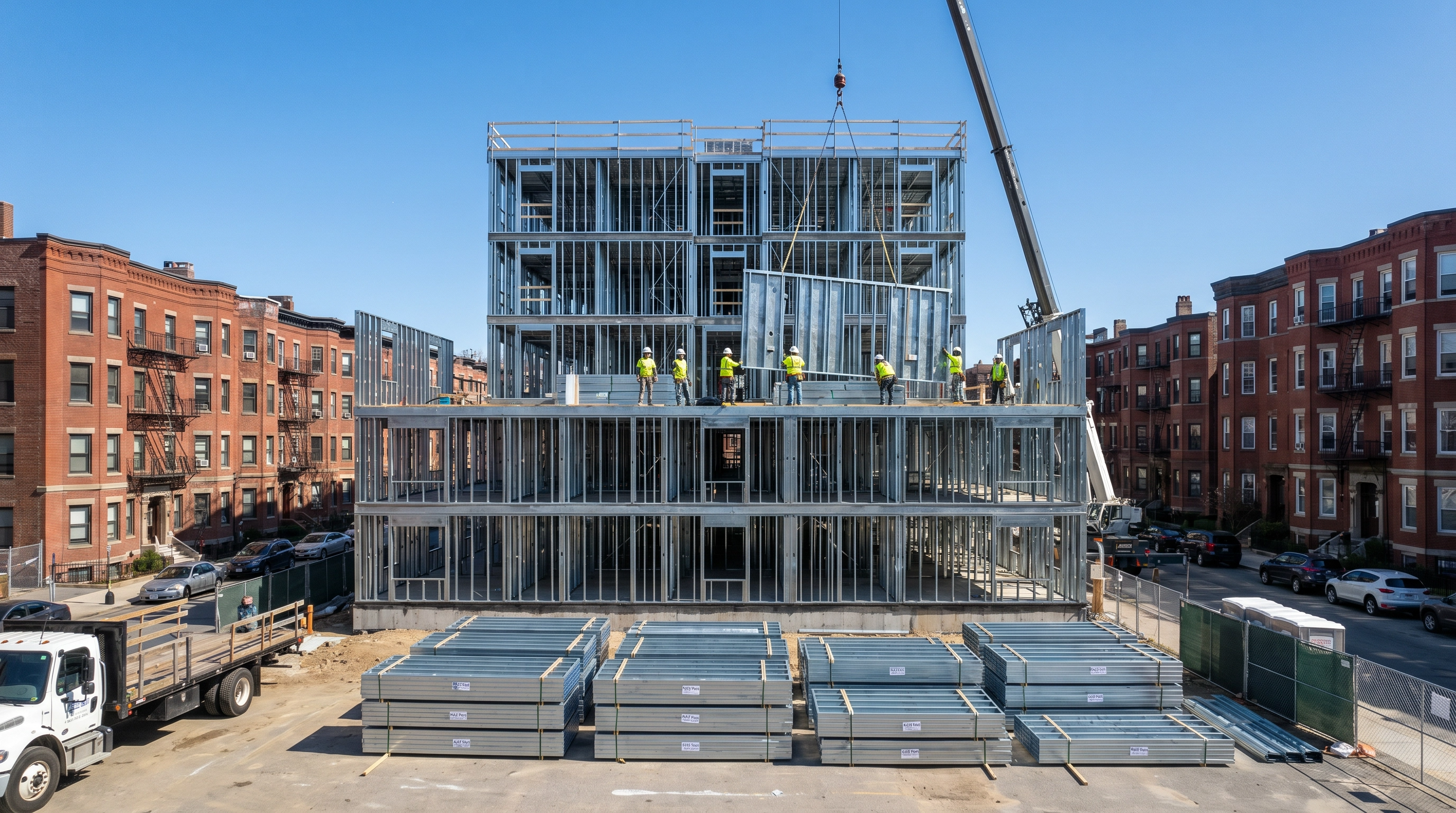
Labor Shortage Solutions: How Panelized CFS Reduces On-Site Framing Crews by 46% — Cost & Schedule Analysis
The New England Framing Labor Crisis and What Developers Are Doing About It
Multifamily developers across Massachusetts and the broader Northeast are facing a compounding problem: construction labor shortages are driving up framing costs, extending schedules, and jeopardizing project financing. Skilled carpenters — particularly those experienced in 5–8 story wood-framed residential construction — are in short supply, and union wage escalation continues to outpace project proformas built even 18 months ago.
The result is a structural mismatch between project economics and available labor. A 150-unit, six-story multifamily building that budgeted $22 per square foot for framing labor two years ago may now carry a realistic cost of $26–28 per square foot, before accounting for schedule delays caused by crew shortages. For developers managing tight debt-service coverage ratios and construction loan timelines, this gap is existential.
Panelized cold-formed steel framing offers a measurable, documented path out of this cost spiral — not as a theoretical alternative, but as a system with quantified labor data across completed New England projects. AAC Steel has compiled engineering analysis and project-level metrics across 5–8 story residential buildings that provides developers and general contractors with the numbers they need to evaluate CFS panelization as a labor mitigation strategy.
"Panelized cold-formed steel framing reduces on-site framing crews by 46% compared to traditional wood construction, cutting labor costs from $18–26 per square foot to $8–12 per square foot on New England multifamily projects, according to AAC Steel's engineering analysis of 5–8 story residential buildings."
This article breaks down exactly how that reduction is achieved — by labor hours, crew composition, wage burden, schedule impact, and ultimate ROI — so you can evaluate the opportunity against your specific project parameters.
On-Site Labor Hours Per Square Foot: Wood vs. Panelized CFS
The most direct measurement of framing labor efficiency is on-site hours per square foot of framed area. This metric strips out wage variables and regional differences to reveal the underlying productivity differential between construction methods.
Traditional Wood Framing Labor Hours
For 4–8 story Type III or Type V wood-framed multifamily construction, industry-documented labor hours typically range from 0.8 to 1.2 hours per square foot of gross framed area. This range reflects the full scope of on-site framing work: stud layout and installation, rim board and blocking, header fabrication, shear panel installation, backing for fixtures and hardware, coordination with mechanical trades for notching and penetrations, and the rework cycle that follows structural inspection.
The higher end of this range — 1.0 to 1.2 hours per square foot — is increasingly common on projects where crews are assembled from less experienced labor due to market availability, or where design coordination issues generate mid-construction change orders. Wood framing is inherently a field-fabrication process: every stud is cut, positioned, and fastened on site, which means every deviation from plan is resolved on site, at skilled-trade billing rates.
Panelized CFS Labor Hours
Precision-fabricated CFS panels delivered to the job site compress on-site framing labor to 0.35 to 0.50 hours per square foot — a reduction of 55 to 65 percent compared to the wood framing benchmark. This figure reflects AAC Steel's project-level data across completed 5–8 story multifamily buildings in the Massachusetts market.
The source of this compression is straightforward: fabrication labor that would otherwise be performed on-site at union carpenter rates is instead performed in a controlled factory environment, with CNC-precision equipment, at lower effective labor rates and zero weather delay exposure. The on-site crew receives panels that are pre-cut, pre-punched, pre-labeled, and sequenced for installation — reducing their role from fabrication to assembly.
| Framing Method | Labor Hours per SF | Labor Cost per SF (New England) | Typical Crew Size (5–8 Story) |
|---|---|---|---|
| Traditional Wood Framing | 0.8 – 1.2 hrs/SF | $18 – $26/SF | 12 – 15 skilled carpenters |
| Panelized CFS (AAC Steel) | 0.35 – 0.50 hrs/SF | $8 – $12/SF | 6 – 8 panel installers |
| Reduction | ~55% fewer hours | $10 – $14/SF savings | 46% smaller crew |
On a 100,000-square-foot building — a representative six-story, 120-unit multifamily project — this labor hour differential translates to a reduction of 45,000 to 85,000 on-site framing labor hours, depending on the wood framing baseline. At fully burdened New England union carpenter rates, that differential carries substantial dollar value.
Wage Burden Comparison: Understanding True Labor Cost in New England
Raw hourly wages are only part of the labor cost equation. Fully burdened labor rates — which include fringe benefits, health insurance contributions, pension fund obligations, payroll taxes, and workers' compensation premiums — tell a different story than the base wage alone.
Union Carpenter Rates in Massachusetts
In the Boston metro and surrounding Massachusetts markets, union carpenter base wages for commercial framing work typically range from $58 to $72 per hour as of current collective bargaining agreements. When fringe benefits, employer payroll taxes, and workers' compensation are applied, fully burdened rates commonly reach $90 to $115 per hour for a working carpenter on a multifamily job site.
Workers' compensation premiums for carpentry classifications in Massachusetts carry some of the highest rate codes in the construction trades — a reflection of the elevated injury risk associated with multi-story framing work, including falls, struck-by incidents, and repetitive-motion claims. For a 15-carpenter crew working 50-hour weeks over an 18-week framing cycle, the aggregate burdened labor cost is substantial before a single panel is erected.
CFS Panel Installer Wage Profile
CFS panel installation on AAC Steel projects is performed by crews trained in panel handling, crane or boom-lift operation, and screw-fastening systems. While these crews operate under appropriate labor agreements, the trade classification and corresponding wage scale differ from commercial carpentry. The effective fully burdened rate for CFS panel installers in the New England market typically runs 15 to 25 percent lower than union carpenter rates for equivalent hours worked.
More importantly, the crew size required is 46 percent smaller: 6 to 8 panel installers accomplish the same structural framing output as 12 to 15 carpenters.
Project Example: Anonymized 6-Story Multifamily, Greater Boston Area
On a recent 112-unit, six-story CFS project completed through AAC Steel's fabrication program, the general contractor documented the following labor performance against the original wood-framing budget scenario:
- Wood framing budget (baseline): $24.50/SF × 94,000 SF = $2,303,000 estimated framing labor
- CFS panel installation actual: $10.80/SF × 94,000 SF = $1,015,200 actual framing labor
- Direct labor savings: $1,287,800 on a single project
- Crew size: 7 CFS installers vs. 13 carpenters estimated for wood scope
- On-site framing duration: 11 weeks vs. 20 weeks estimated for wood framing
These figures represent documented project data, not modeled projections. The savings were sufficient to fully offset the panel fabrication premium — the cost delta between stick-built material and factory-fabricated CFS panels — within the construction period itself, before any schedule-related savings were applied.
Schedule Acceleration: Converting Crew Reduction Into Financing Savings
Labor savings per square foot are a direct line item. Schedule acceleration creates a second, often larger category of savings that many developers undercount in their initial CFS evaluation.
"By delivering precision-fabricated CFS panels to the job site, developers eliminate 8–10 weeks of traditional carpentry work, reducing crew size from 12–15 skilled carpenters to 6–8 panel installers, directly addressing the Northeast's acute labor shortage in residential framing."
Structural Completion Timeline Reduction
AAC Steel's project data shows a consistent pattern: panelized CFS framing reduces structural completion time by 8 to 12 weeks per 100,000 square feet of building area on 5–8 story multifamily projects, compared to equivalent wood-framed construction timelines. This compression occurs for three reinforcing reasons.
First, smaller crews working with pre-fabricated panels maintain faster linear installation rates than larger crews performing field fabrication. Panel installation is a sequenced, predictable activity; wood framing involves continuous micro-decisions and field measurement that introduce variability into the daily productivity rate.
Second, CFS panel delivery schedules are coordinated with BIM models during the design phase, eliminating the coordination conflicts between framing, mechanical, electrical, and plumbing trades that routinely add 2–4 weeks of delay to wood-framed projects. Penetrations, chase locations, and bearing conditions are resolved before the first panel is fabricated — not after the walls are standing.
Third, AAC Steel's precision fabrication achieves 95%+ dimensional accuracy across panel assemblies, which virtually eliminates the rework cycles that consume 8–12% of traditional wood framing labor hours on complex multifamily floor plans. When panels land within tolerance, inspections pass on the first attempt and downstream trades — drywall, mechanical, exterior cladding — can begin on schedule.
General Conditions and Financing Cost Impact
For a $45 million construction loan on a 6-story multifamily project, an 8-week schedule reduction represents meaningful savings across two categories: general conditions and construction loan interest.
General conditions — superintendent, site trailer, temporary utilities, insurance, site security — typically run 8 to 12 percent of total construction cost on multifamily projects. At $45 million, that is $3.6 to $5.4 million in total general conditions. Each week saved reduces general conditions by approximately $70,000 to $100,000. Eight weeks of schedule compression saves $560,000 to $800,000 in general conditions alone.
Construction loan interest at current rates adds further savings. At a $45 million loan balance and a 7.5% construction loan rate, each week of schedule reduction saves approximately $64,900 in carrying costs. Eight weeks equals $519,200 in interest savings.
Combined, an 8-week schedule reduction on a representative New England multifamily project produces $1.07 million to $1.31 million in general conditions and financing savings, layered on top of the direct labor cost reduction.
Code Compliance and Fire Safety: CFS Meets the Same Standards
A common question from developers evaluating CFS for the first time is whether the labor and cost advantages come with code compliance trade-offs. The answer is unambiguous: they do not.
"Cold-formed steel panelization achieves this labor reduction without sacrificing code compliance: Type IIB fire-rated assemblies meet ASTM E119 two-hour fire-resistance requirements while requiring 46% fewer on-site labor hours, making it a viable solution for multifamily projects facing both labor and budget constraints."
AAC Steel's CFS panel systems are engineered to comply with IBC Type IIB construction classification and Massachusetts 780 CMR, delivering two-hour fire-resistance ratings tested and certified under ASTM E119 and referenced in UL Design Guide assembly listings. Non-combustible steel framing does not contribute fuel load to a fire event — a fundamental advantage over wood-framed construction that carries direct implications for insurance underwriting and occupant life safety.
Eliminating the Concrete Podium Requirement
In Massachusetts and across the Northeast, many 5–8 story mixed-use multifamily projects have historically required a concrete podium to separate residential wood-framed construction from ground-level retail or parking — a cost of $4 to $8 million on a typical urban project.
AAC Steel's non-combustible CFS framing system eliminates this requirement. The entire building — including ground-floor commercial or parking levels — can be constructed with CFS framing in a Type IIB assembly, removing the podium cost from the project budget entirely. This represents a third category of savings that compounds the labor and schedule advantages described above.
Labor Shortage Mitigation: Fewer Specialized Trades Required
The strategic advantage of panelized CFS extends beyond cost per square foot. In a regional labor market where experienced multi-story wood framers are genuinely scarce, the ability to complete structural framing with a 6–8 person crew is a risk management tool, not merely a cost optimization.
Reducing Dependency on Carpenter Availability
A 15-carpenter framing crew requires a general contractor to secure 15 workers with the specific experience level demanded by 5–8 story residential framing: knowledge of complex floor plans, multi-story bearing systems, shear wall layout, and coordination with structural engineers for field conditions. In Greater Boston and the surrounding submarkets, that pool of available, experienced workers is constrained and increasingly competitive.
A 6–8 person CFS panel installation crew operates from a dramatically smaller labor pool requirement. Panel installation is a trainable, repeatable skill set with a shorter learning curve than traditional multi-story carpentry. AAC Steel's panel delivery sequencing and installation documentation further reduces the expertise threshold for the on-site crew, because the complex decisions — layout, tolerance, structural coordination — are resolved during the BIM-coordinated fabrication process, not on the job site.
Predictable Labor Performance
The factory fabrication model also shifts labor performance risk from the job site to the manufacturing facility. When wood framing productivity varies due to crew experience, weather, plan changes, or material delivery issues, the general contractor absorbs the cost in real time. With panelized CFS, AAC Steel's fabrication schedule is a contractual commitment, and panel delivery logistics are managed against a BIM-coordinated sequence that the on-site crew can execute predictably.
For general contractors managing multiple projects with shared superintendents and project managers, this predictability reduces supervisory overhead and allows project management resources to be allocated more efficiently across the portfolio.
ROI Analysis: When Do the Numbers Pay Back?
Panelized CFS panels carry a fabrication premium over raw stick-built materials — typically $2 to $4 per square foot in fabrication cost above equivalent wood framing material costs, depending on project complexity and panel specification. Developers who focus on this line-item premium without accounting for the offsetting savings categories consistently misread the total project economics.
When direct labor savings ($10–14/SF), general conditions acceleration ($5.60–8.00/SF equivalent), construction loan interest savings ($4.50–6.50/SF equivalent), and eliminated podium costs are aggregated against the panel fabrication premium, the net economic case for panelized CFS is strongly positive on any 5-story or taller multifamily project in the New England market. AAC Steel's analysis of completed projects indicates that labor savings alone offset the panel fabrication premium within 6 to 9 months of project completion — before stabilized occupancy, refinancing, or disposition events are considered.
| Savings Category | Typical Range (per SF) | 100,000 SF Project Total |
|---|---|---|
| Direct Labor Savings | $10 – $14/SF | $1,000,000 – $1,400,000 |
| General Conditions Reduction | $5.60 – $8.00/SF | $560,000 – $800,000 |
| Construction Loan Interest Savings | $4.50 – $6.50/SF | $450,000 – $650,000 |
| Rework and Waste Elimination | $1.50 – $3.00/SF | $150,000 – $300,000 |
| Total Savings | $21.60 – $31.50/SF | $2,160,000 – $3,150,000 |
| Panel Fabrication Premium | $2 – $4/SF | $200,000 – $400,000 |
| Net Project Benefit | $17.60 – $27.50/SF | $1,760,000 – $2,750,000 |
These figures represent conservative estimates derived from AAC Steel's completed project data. Developers with higher union wage exposures, more complex floor plans, or aggressive delivery schedules will typically realize returns at the higher end of these ranges.
Ready to run the numbers on your project? Download AAC Steel's Labor Mitigation ROI Calculator: Input your project size, union wage rates, and timeline to see exact labor cost savings and crew reduction for your 4–8 story multifamily project. Get three competitive quotes from AAC Steel fabrication engineers. Contact AAC Steel's engineering team today to begin the analysis with your actual project parameters.
Frequently Asked Questions
How does panelized CFS actually reduce crew size from 15 carpenters to 6–8 installers?
Traditional wood framing requires a large crew because nearly all fabrication — cutting, measuring, layout, blocking, backing — occurs on site. With AAC Steel's panelized CFS system, those fabrication tasks are completed at our manufacturing facility using CNC equipment and BIM-coordinated design data. The on-site crew receives fully fabricated, labeled, and sequenced panels that need only to be positioned, plumbed, and fastened. The reduction in crew size reflects the shift of fabrication labor from the job site to the factory, not a reduction in the total work performed.
Does panelized CFS cost more per square foot than wood framing overall?
The fabrication cost of CFS panels carries a $2–4 per square foot premium over raw wood framing materials. However, when direct labor savings ($10–14/SF), general conditions acceleration, reduced construction loan interest, and eliminated rework costs are applied, the net economic benefit of panelized CFS is strongly positive — typically $17.60–27.50 per square foot on New England multifamily projects. The panel fabrication premium is offset by labor savings within 6–9 months of project completion, according to AAC Steel's analysis of completed projects.
Are CFS-framed multifamily buildings compliant with Massachusetts building codes?
Yes. AAC Steel's CFS panel systems are fully compliant with IBC construction classifications and Massachusetts 780 CMR. Our assemblies deliver two-hour fire-resistance ratings tested under ASTM E119 and listed in UL Design Guide assemblies, meeting IBC Type IIB requirements for 5–8 story residential construction. Non-combustible CFS framing can also eliminate the concrete podium requirement that adds $4–8 million to many Massachusetts mixed-use projects under Type IIIA or Type VA wood-framed design approaches.
How does schedule reduction translate to actual financial savings for a developer?
Schedule reduction creates savings in two primary categories: general conditions (superintendent, insurance, site overhead, temporary utilities) and construction loan interest. On a representative $45 million multifamily project, each week of schedule reduction saves approximately $70,000–$100,000 in general conditions and $64,900 in construction loan interest at current rates. An 8-week structural framing schedule reduction yields $1.07 million to $1.31 million in direct financial savings.
What is the lead time for AAC Steel CFS panel fabrication, and how does it integrate with a construction schedule?
AAC Steel's panel fabrication process integrates with BIM coordination during the design development and construction document phases, so fabrication lead time does not add calendar duration to a well-sequenced project. Typical fabrication lead times for 5–8 story multifamily projects range from 10 to 16 weeks from final engineered drawings, which aligns with foundation and site work timelines on most projects. AAC Steel's engineering team works directly with the project's design and construction team to establish a panel delivery sequence that supports the GC's master schedule from the earliest project phases.
Labor cost figures, hours per square foot, and schedule reduction data are derived from AAC Steel's engineering analysis of completed 5–8 story multifamily projects in the New England market and reflect project-specific conditions. Individual project results will vary based on project complexity, site conditions, union agreements, and design parameters. All fire-resistance ratings reference tested assemblies per ASTM E119; consult AAC Steel's engineering team for project-specific code compliance analysis under IBC and Massachusetts 780 CMR.