Steel vs. Wood Framing for Multifamily Construction
By Carlos Ferreira · April 13, 2026
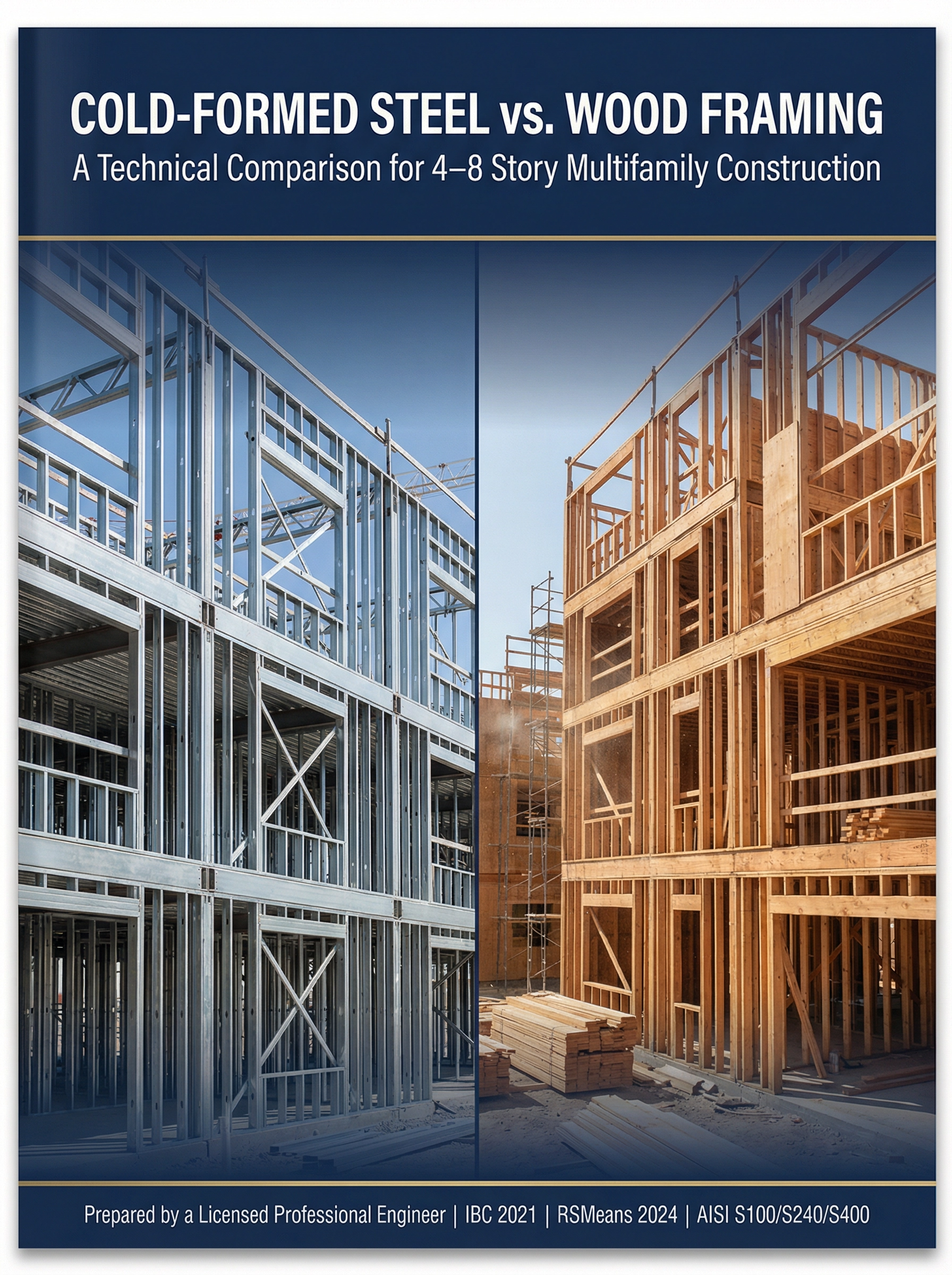
Steel vs. Wood Framing: A Complete Technical Comparison for Multifamily Construction
Executive Summary
When developers, structural engineers, and general contractors evaluate framing systems for 4–8 story multifamily projects, the decision between cold-formed steel (CFS) and wood framing involves far more than material unit cost. It requires a comprehensive evaluation of IBC construction type classifications, fire performance per ASTM E119, insurance underwriting criteria, schedule risk, and 30-year lifecycle costs.
This technical comparison, prepared by a licensed Professional Engineer with 30+ years of CFS design and fabrication experience, provides a data-driven framework for that evaluation. The findings are grounded in RSMeans 2024 cost data, AISI S100/S240/S400 design standards, IBC 2021 construction type requirements, and UL fire-rated assembly specifications.
Key findings: At four stories and below, wood framing typically has a lower installed cost. At five stories, CFS reaches cost parity. At six stories and above, CFS provides an increasing cost advantage driven primarily by the elimination of the Type IA concrete podium structure and fire-retardant treatment (FRT) lumber requirements that wood framing imposes at those heights. Over a 30-year lifecycle on a 68,498 SF multifamily building, CFS provides a documented total savings of approximately $5.4 million (37.5%) compared to equivalent wood construction.
- 4 stories and below: Wood framing typically saves $8–10/SF — appropriate for budget-driven, low-rise residential
- 5 stories: Cost parity — full lifecycle analysis strongly favors CFS once podium and insurance are included
- 6 stories and above: CFS saves approximately $13.42/SF at 6 stories and $21.11/SF at 7 stories (RSMeans 2024, Boston market)
- 30-year lifecycle: CFS advantage of approximately $5.4 million on a 68,498 SF documented project
IBC Construction Type Classifications: The Foundation of the Decision
The most fundamental difference between CFS and wood framing for mid-rise construction is not material cost — it is the IBC construction type classification each material enables, and the height, area, and fire protection requirements that flow from that classification under IBC 2021 Tables 504.3, 504.4, and 601.
Cold-Formed Steel: Non-Combustible Type IIA and IIB Construction
Cold-formed steel is classified as non-combustible per IBC 602.2 and ASTM E136. This qualifies CFS-framed buildings for Type IIA and Type IIB construction — the highest non-combustible classification achievable without a structural concrete or hot-rolled steel frame.
Under IBC 2021 Tables 504.3 and 504.4 for Group R-2 occupancy with NFPA 13 sprinkler systems installed throughout:
| Construction Type | Max Stories (R-2, Sprinklered) | Max Height (ft) | Structural Frame Fire Rating (IBC Table 601) | CFS Bearing Wall Protection Required? |
|---|---|---|---|---|
| Type IIB | 5 stories | 75 ft | 0 hours | No — unprotected CFS permitted |
| Type IIA | 5 stories | 85 ft | 1 hour | Yes — UL H514 or equivalent required |
| Type IB | 12 stories | 180 ft | 2 hours | Yes — UL H505 or equivalent required |
IBC §510.2 permits a single-story Type IA podium to support Type IIB above, enabling a total of 6 stories (1 podium + 5 Type IIB). IBC §510.4 permits a two-story Type IA podium enabling 7 stories total. IBC §510.6 provides an additional pathway to 7–9 stories for qualifying Type IIA buildings on large lots with primarily residential occupancy. Each portion above and below the horizontal separation is treated as a separate building for height and area calculations.
Wood Framing: Combustible Types IIIA, IIIB, and VA
Wood framing is a combustible material. It qualifies for Type IIIA (1-hour exterior non-combustible, 1-hour interior) or Type IIIB (0-hour exterior non-combustible, combustible interior) when combined with non-combustible exterior cladding. Without non-combustible exterior treatment, wood framing falls to Type VA (1-hour) or Type VB (0-hour).
The critical limitation: wood-framed buildings exceeding 4 stories require IBC §510 podium construction — a Type IA (concrete or structural steel) base structure onto which the wood-framed upper floors are placed. This podium requirement is the primary economic driver separating CFS and wood framing economics at 5+ stories.
| Construction Type | Framing Material | 5-Story Option | Podium Required? | FRT Lumber Required? |
|---|---|---|---|---|
| Type IIB / IIA | CFS (non-combustible) | Yes — full 5-story CFS | No | No |
| Type IIIA / IIIB | Wood (combustible, exterior NC) | Requires podium per IBC §510 | Yes | Yes — Type IIIA |
| Type VA | Wood (combustible) | Limited to 4 stories without podium | Yes (for 5+) | No (but height limited) |
Structural Performance Comparison
Material Properties and Design Standards
CFS structural members are designed per AISI S100 (North American Specification for the Design of Cold-Formed Steel Structural Members) using the Effective Width Method or Direct Strength Method. Steel yields at 33–50 ksi (Fy) with modulus of elasticity at 29,500 ksi. Wood members are designed per the National Design Specification (NDS), with design values that vary by species, grade, moisture condition, and load duration factor (CD).
| Property | Cold-Formed Steel (CFS) | Wood Framing (SPF #2) |
|---|---|---|
| Design Standard | AISI S100 / S240 / S400 | NDS 2018 / SDPWS 2021 |
| Yield Strength / Bending Value | Fy = 33–50 ksi | Fb = 875 psi (bending, SPF #2 2×6) |
| Modulus of Elasticity | 29,500 ksi | 1,200 ksi |
| Fabrication Tolerance | ±1/8" (CNC roll-forming) | ±1/4"–3/8" field tolerance |
| Moisture-Driven Shrinkage | Negligible (inorganic material) | 3–8% cross-grain shrinkage during drying |
| Biological Resistance | Immune to termites, fungal decay, mold | Susceptible — treatment required above 2 stories |
| Fire Classification | Non-combustible per IBC 602.2 / ASTM E136 | Combustible — ignites at 400–500°F |
| Recycled Content | ~25–35% recycled steel content (typical) | Renewable — forestry-dependent supply chain |
Dimensional Stability Over Building Height
One of the most consequential differences between CFS and wood in multi-story construction is dimensional stability under occupancy. Wood framing shrinks cross-grain as it dries following construction — typically 3–8% for SPF framing lumber installed at above-equilibrium moisture content. In a 5-story building with 2×10 floor framing at each level, accumulated shrinkage can reach 1–2 inches over building height, causing nail pops, drywall cracking at corners, plumbing binding at penetrations, and elevator door alignment problems.
CFS members maintain dimensional stability within ±1/8" fabrication tolerance. Factory-fabricated CFS panels are produced by HOWICK CNC roll-forming equipment to precise digital models, eliminating the site-cut variation that characterizes stick framing. This dimensional precision reduces call-backs, punch list items, and long-term maintenance costs that are not captured in initial framing cost comparisons.
Lateral System Design: AISI S400 vs. SDPWS
Lateral force-resisting system design for CFS framing is governed by AISI S400 (North American Standard for Seismic Design of Cold-Formed Steel Structural Systems). CFS shear walls with steel sheathing or wood structural panels provide lateral resistance in accordance with AISI S400 provisions, with hold-down forces and anchor rod specifications calculated for the specific seismic and wind loading criteria per ASCE 7-22. Wood shear walls are designed per SDPWS 2021 with plywood or OSB sheathing. Both systems deliver code-compliant lateral performance when properly engineered; the distinction is the design standard referenced and the connection engineering required.
Fire Performance: Non-Combustible vs. Combustible Systems
The Fundamental Material Difference
CFS melts at approximately 2,700°F. Wood ignites at 400–500°F and contributes fuel load during a fire event. Once gypsum board protection is breached in a wood-framed building, the structural frame itself becomes a fuel source. In a CFS-framed building, the structural frame is non-combustible per ASTM E136 — it does not add to the fire's fuel load once the gypsum assembly is compromised.
This distinction has demonstrated real-world consequences. The November 2025 UMass Amherst fire resulted in complete structural collapse of a wood-framed building within 30 minutes, displacing 232 students. A student housing complex in College Park, Maryland experienced $39 million in structural damage from fire propagation through combustible framing. CFS construction eliminates this failure mode at the material level.
UL Fire-Rated Assembly Options for CFS Construction
CFS construction achieves fire-resistance ratings through tested assemblies listed in the UL Fire Resistance Directory. Importantly, Type IIB CFS construction requires zero hours of structural frame fire protection per IBC Table 601. Fire-rated assemblies are required only for occupancy separations, floor/ceiling assemblies, corridor walls, and shaft enclosures — requirements that apply equally to wood construction at the same building heights.
| UL Design | Fire Rating | Application | Key Assembly Parameters |
|---|---|---|---|
| H505 | 2-hour | CFS load-bearing wall — Type IIA or occupancy separation | CFS studs 3-5/8"–6" @ 16"/24" o.c.; two layers 5/8" Type X gypsum each side; ASTM E119 tested |
| H514 | 1-hour | CFS load-bearing wall — Type IIA structural frame protection | CFS studs; single layer 5/8" Type X gypsum each side; fastening per UL listing |
| L541 | 1-hour | CFS floor/ceiling assembly | CFS C-joists 8"–12" @ 24" o.c.; structural deck + 5/8" Type X gypsum ceiling on resilient channel @ 16" o.c. |
| G602 | 3-hour | CFS floor/ceiling — eliminates structural concrete topping | Min. 18 ga / 43 mil CFS C-joists, ASTM A1003 SS G60; USG STRUCTO-CRETE 3/4" nom. T&G; #10 S-D screws @ 6" o.c. perimeter / 8" o.c. field; three layers 5/8" Type X gypsum on resilient channel |
| M527 | 1-hour | CFS non-load-bearing corridor wall | CFS studs @ 16"/24" o.c.; single layer 5/8" Type X gypsum per side; applicable to sprinklered R-2 corridors per IBC Table 1020.1 |
| N501 / D902 | 2-hour | CFS shaft wall and area separation wall | ClarkDietrich CFS shaftwall system with E-stud framing; 1" Type X liner panels; gypsum face layers per UL listing; required for 4+ story shaft enclosures per IBC 713 |
UL Design G602 deserves specific attention as a key CFS competitive differentiator. This assembly achieves a 3-hour ASTM E119 floor/ceiling rating without structural steel deck or concrete topping slab, using USG STRUCTO-CRETE fiberglass-reinforced cement panels over CFS C-joists. The assembly replaces a composite deck/concrete floor weighing 50–65 psf with an assembly weighing only 12–18 psf — reducing supporting member sizes, foundation demands, and eliminating concrete placement, curing delays, and composite floor design complexity.
Cost Analysis: The Full-System Economic Picture
The persistent misconception that CFS is significantly more expensive than wood framing is based on material unit cost comparisons that exclude the podium requirement, FRT lumber premiums, schedule value, and insurance differential that govern total project economics at 5+ stories. A full-system cost analysis produces a materially different conclusion.
Framing Cost by Building Height (RSMeans 2024, Boston Metro Market)
| Building Height | IBC Type (Wood) | Wood Framing Cost ($/SF) | IBC Type (CFS) | CFS Framing Cost ($/SF) | Cost Differential |
|---|---|---|---|---|---|
| 4 Stories | Type VB / IIIB | $14.50–$16.50 | Type IIB | $24.00–$26.00 | Wood saves ~$9–10/SF |
| 5 Stories | Type IIIB + podium | $23.50–$29.50 | Type IIB | $24.50–$26.50 | Cost parity range |
| 6 Stories | Type IIIA + FRT + podium | $31.00–$37.00 | Type IIA | $26.00–$28.00 | CFS saves ~$13.42/SF |
| 7 Stories | Type IIIA + FRT + podium | $38.00–$46.00 | Type IIA | $27.00–$29.00 | CFS saves ~$21.11/SF |
Sources: RSMeans 2024 (Boston market); SFIA industry cost data; BuildSteel.org case studies. All figures are estimates — project-specific conditions affect final costs. Flag: lumber pricing has experienced 300% historical volatility. Verify current pricing against RSMeans quarterly updates before incorporating into project budgets.
The FRT Lumber Cost Penalty Above 4 Stories
Above 4 stories, wood-framed buildings classified as Type IIIA require fire-retardant-treated (FRT) lumber throughout the structural frame. FRT lumber imposes costs beyond material price that are frequently omitted from preliminary budget comparisons:
- Structural capacity reduction: Treatment chemicals reduce bending design values by 10–25%, requiring larger member sizes to carry equivalent loads per NDS Table 5A adjustments
- Fastener upgrade: Stainless steel fasteners required — adds $0.25–$0.40/SF to installed cost
- Procurement lead time: 6–12 weeks for FRT lumber versus 4–6 weeks for standard framing lumber, adding schedule risk
- Special inspection requirements: Additional third-party inspection for FRT lumber systems adds $3,000–$5,000 per project
- Total FRT impact on a 60,000 SF 6-story building: Estimated $294,000–$465,000 in additional framing costs versus standard wood specification
Cold-formed steel framing uses standard ASTM A1003 Grade 33/50 galvanized coil at all building heights. There is no height-driven material substitution, no design value reduction, and no specialty fastener requirement. The CFS specification at 6 stories is identical to the specification at 5 stories.
Podium Elimination Economics
The single largest cost driver distinguishing CFS from wood framing at 5+ stories is the Type IA concrete podium structure that wood framing requires per IBC §510. A Type IA podium typically adds $12–15/SF in construction cost to the building footprint plus 8–12 weeks of formwork, concrete placement, and cure cycle before wood framing can begin. At a carrying cost of $50,000–$150,000 per month (project-dependent), that schedule impact alone can represent $100,000–$1.5M in financing cost that does not appear in the framing cost comparison.
CFS-framed buildings at 5+ stories require no podium. The full-height non-combustible steel structure is permitted under Type IIB (5 stories / 75 ft) or Type IIA (5 stories / 85 ft) without any horizontal building separation or podium provisions.
Thermal Performance: Solving the Thermal Bridging Challenge
The most frequently cited disadvantage of CFS framing is thermal bridging through the highly conductive steel studs. Steel's thermal conductivity of approximately 25–50 W/m·K is significantly higher than wood's 0.12 W/m·K, creating heat flow pathways through stud flanges that reduce the effective R-value of a cavity-insulated CFS wall without continuous insulation.
The solution is continuous exterior insulation (ci) applied outboard of the CFS framing, which physically interrupts the thermal bridge at each stud flange. Per ASHRAE 90.1 Appendix A Modified Zone Method, the effective U-factor of a CFS wall with both cavity and continuous insulation is calculated accounting for the steel frame's thermal influence zone.
| CFS Wall Assembly Configuration | Cavity Insulation | Continuous Insulation (ci) | Effective U-Factor | Code Compliance |
|---|---|---|---|---|
| CFS — no continuous insulation | R-13 batt | None | ~U-0.125 | Does not meet IBC 2021 |
| CFS — IBC 2021 base code | R-13 batt | R-7.5 polyiso (RMAX ECOMAXci) | ~U-0.064 | IBC 2021 / 780 CMR base code ✓ |
| CFS — MA stretch energy code | R-19 batt | R-15 polyiso (RMAX ECOMAXci) | ~U-0.051 | 780 CMR stretch code (MA) ✓ |
| Wood — IBC 2021 base code | R-21 batt (2×6) | R-5 ci | ~U-0.059 | IBC 2021 base code ✓ |
Schedule Performance and Constructability
Prefabricated CFS panel systems fundamentally change the construction delivery model for mid-rise multifamily. Rather than site-cutting and hand-stacking individual members, CFS panelized systems deliver factory-fabricated wall panels, floor joist assemblies, and header components to the site in sequenced bundles aligned with the erection schedule. This factory-to-field workflow eliminates site layout, material handling, field cutting, and waste management from the framing phase.
Quantified Schedule Performance
| Performance Metric | CFS Panelized Framing | Wood Stick Framing Baseline |
|---|---|---|
| Framing Phase Duration | ~7–8 weeks (equivalent scope) | ~16–18 weeks (equivalent scope) |
| Schedule Compression | 50–60% reduction vs. stick-framing baseline | Baseline |
| Schedule Variance | <7% planned vs. actual | 15–25% typical variance |
| On-Site Labor Reduction | 40–60% fewer field labor hours for framing phase | Baseline |
| Material Waste | <2% panel waste | 10–15% dimensional lumber waste |
| Fabrication Tolerance | ±1/8" CNC-manufactured | ±1/4"–3/8" field cut |
Crew Training and Learning Curve
The primary construction management challenge in CFS adoption is crew familiarity. CFS framing requires screw guns (not pneumatic nail guns), metal-cutting blades, and panel erection sequencing from engineered drawings. The learning curve is well-documented and typically resolved within one to two projects:
- Days 1–3 (first project): 50–65% of baseline productivity — procedure familiarization and panel handling
- Days 4–10: 70–85% — crews develop panel erection rhythm and efficiency
- Second project: 90–100%+ of wood-framing baseline
- Subsequent projects: Often exceed wood productivity due to eliminated field layout, cut-list management, and waste handling
AAC Steel provides pre-construction crew training and on-site supervision during initial panel erection — typically 1–3 days — to accelerate the learning curve on pilot projects. Tool requirements: screw guns, magnetic drill, metal-cutting circular saw (backup cuts only), laser level, and digital inclinometer.
30-Year Lifecycle Cost Analysis
First-cost comparison captures only a fraction of the total economic case for CFS in mid-rise multifamily. Lifecycle cost analysis over a 30-year ownership period on a 68,498 SF residential building (documented project data, NPV at 4% discount rate) shows the following CFS advantages:
| Cost Category | CFS 30-Year NPV Savings | Primary Driver |
|---|---|---|
| Initial Construction | $2,211,717 (24.7%) | Podium elimination at 5+ stories |
| Property Insurance (30 years) | $666,288 | Non-combustible classification — up to 38.2% annual premium reduction |
| Maintenance (30 years) | $585,848 | No rot repair, termite treatment, moisture remediation, or floor leveling |
| Major Capital Repairs (30 years) | $642,385 | No structural degradation, no FRT re-inspection requirements |
| Energy Costs (30 years) | $261,085 | Properly detailed continuous insulation assembly |
| Total 30-Year Lifecycle Advantage | ~$5,400,000 (37.5%) | Documented project outcome — individual results vary by size and market |
Data represents documented project results and projections using stated methodology. Individual project outcomes will vary based on size, location, occupancy, and market conditions. Insurance savings projected at 38.2% premium reduction versus wood construction; actual savings depend on carrier and underwriting criteria. All cost figures should be verified against current RSMeans data and regional market conditions at time of project evaluation.
Risk Factor Comparison
| Risk Factor | Cold-Formed Steel | Wood Framing |
|---|---|---|
| Fire propagation | Minimal — non-combustible frame | High — combustible frame adds fuel load |
| Water / moisture damage | Surface only — steel unaffected | Severe — structural damage, mold potential |
| Biological degradation | None — immune to pests and fungal decay | Significant — termites, carpenter ants, rot |
| Long-term structural drift | Stable — no shrinkage or creep | Progressive — cross-grain shrinkage over time |
| Material price volatility | Moderate — steel pricing relatively stable | High — lumber experienced 300% price swings |
| Construction-phase fire risk | Minimal — non-combustible throughout | High — fully combustible during framing phase |
Decision Guidance by Building Height
Wood framing is a well-established, cost-effective system for low-rise residential construction. The framing system selection decision is primarily governed by building height and project economics:
- 1–3 stories: Wood framing typically provides lower first-cost and is often the appropriate choice unless non-combustibility, insurance requirements, or site conditions create specific CFS advantages for the project.
- 4 stories: Evaluate both systems. The CFS first-cost premium of approximately $8–10/SF may be partially or fully offset by insurance savings, schedule advantages, and long-term maintenance. Projects with fire-sensitivity requirements (institutional ownership, lender-driven insurance requirements, ADU programs) may favor CFS.
- 5 stories: Cost parity. Full lifecycle analysis strongly favors CFS. The podium requirement for wood adds 8–12 weeks of schedule and $12–15/SF to wood's apparent material advantage, eliminating the cost difference.
- 6+ stories: CFS provides an increasing cost advantage — $13.42/SF at 6 stories, $21.11/SF at 7 stories (RSMeans 2024, Boston market). CFS is the structurally and economically superior choice for mid-rise multifamily at these heights.
Massachusetts-Specific Requirements (780 CMR)
Massachusetts enforces the IBC through 780 CMR (Massachusetts State Building Code, 10th Edition) with state-specific amendments. Several requirements are more restrictive than IBC 2021 base code and directly affect CFS and wood system selection on Massachusetts projects:
- High-rise threshold: 780 CMR defines high-rise at 70 feet measured from grade plane to building height — not fire department vehicle access elevation to highest occupied floor as IBC measures. This creates a more restrictive and differently measured standard that can affect projects near the threshold.
- Exterior wall fire testing: 780 CMR 1403 requires NFPA 285 testing for all exterior wall assemblies on buildings over 40 feet. All components — CFS framing, cavity insulation, continuous insulation, air/moisture barrier, and cladding — must be part of a tested and listed system.
- Stretch energy code: Municipalities adopting the Massachusetts Stretch Energy Code require a minimum of R-13 cavity + R-7.5 ci for CFS exterior wall assemblies in Climate Zone 5A. HERS Index ≤ 42 for mixed-fuel buildings; ≤ 45 for all-electric.
- Dual-authority jurisdiction: Sprinkler system design and approval in Massachusetts falls under 527 CMR (fire official authority), separate from 780 CMR (building official authority). Both permits are required; early coordination between structural/architectural design and fire protection engineering is critical to avoid permit delays.
- Special inspection: IBC Section 1705.11, as adopted by 780 CMR, requires special inspection of CFS framing for load-bearing structural members. The inspection program must be developed and submitted with permit application.
Frequently Asked Questions
Is cold-formed steel more expensive than wood framing for apartment buildings?
At 1–4 stories, yes — CFS framing typically costs $8–10/SF more than wood in Boston market conditions per RSMeans 2024. At 5 stories, the systems reach cost parity when the Type IA concrete podium requirement for wood framing is included. At 6 stories and above, CFS provides a cost advantage of $13–21/SF because it eliminates the podium entirely and avoids FRT lumber premiums — 10–25% structural capacity reduction requiring upsized members, stainless fasteners at $0.25–$0.40/SF, and 6–12 week lead times — that wood framing incurs at those heights.
What IBC construction type does cold-formed steel qualify for?
CFS is non-combustible per IBC 602.2 and ASTM E136, qualifying for Type IIA (1-hour structural frame) or Type IIB (0-hour structural frame). Under IBC 2021 Tables 504.3 and 504.4, Group R-2 with NFPA 13 sprinklers, Type IIB permits 5 stories / 75 ft and Type IIA permits 5 stories / 85 ft. IBC §510 podium provisions allow additional height — up to 6 total stories under §510.2 (single-story Type IA podium), 7 stories under §510.4 (two-story podium), or 7–9 stories under §510.6 for qualifying large-lot residential sites. Wood framing requires a Type IA podium for 5-story and taller buildings.
How does cold-formed steel address thermal bridging?
Thermal bridging through CFS studs is mitigated with continuous exterior insulation (ci). A CFS wall with R-13 cavity insulation plus R-7.5 polyisocyanurate continuous insulation (RMAX ECOMAXci) achieves an effective U-factor of approximately U-0.064, meeting IBC 2021 base code for commercial multifamily in Climate Zone 5A. R-19 + R-15 ci achieves U-0.051 for Massachusetts stretch energy code compliance. Effective U-factors are calculated per the ASHRAE 90.1 Appendix A Modified Zone Method.
How does panelized CFS framing reduce construction time?
Prefabricated CFS panels are manufactured to ±1/8" CNC tolerances and delivered in sequenced bundles. This eliminates site layout, field cutting, and waste management from the framing workflow. Documented project data shows 50–60% framing schedule compression versus stick-framing baseline, schedule variance below 7%, and 40–60% reduction in field labor hours for the framing phase. The schedule compression value compounds with earlier tenant occupancy, reduced financing carry, and predictable milestone achievement.
What fire rating can cold-formed steel achieve for floor/ceiling assemblies?
CFS floor/ceiling assemblies achieve 1-hour ratings under UL Design L541 and 3-hour ratings under UL Design G602. G602 is particularly significant because it achieves a 3-hour ASTM E119 rating without structural steel deck or concrete topping slab, using USG STRUCTO-CRETE cement panels over CFS C-joists. This eliminates concrete placement, curing delays, and composite floor design complexity while reducing dead load from 50–65 psf (composite deck) to 12–18 psf (G602 assembly).
References and Standards
- IBC 2021: International Building Code — Sections 602.2, 713, Tables 504.3, 504.4, 601, 602, 508.4, 1020.1; Section 510 podium provisions. International Code Council.
- AISI S100-16 (2020): North American Specification for the Design of Cold-Formed Steel Structural Members. American Iron and Steel Institute.
- AISI S240-20: North American Standard for Cold-Formed Steel Structural Framing.
- AISI S400-20: North American Standard for Seismic Design of Cold-Formed Steel Structural Systems.
- ASCE 7-22: Minimum Design Loads and Associated Criteria for Buildings and Other Structures.
- ASTM E119: Standard Test Methods for Fire Tests of Building Construction and Materials.
- ASTM E136: Standard Test Method for Behavior of Materials in a Vertical Tube Furnace at 750°C (Non-Combustibility).
- ASTM E84: Standard Test Method for Surface Burning Characteristics of Building Materials (Flame Spread / Smoke Development).
- UL Fire Resistance Directory: UL Designs H505, H514, L541, G602, M527, N501, D902, D925. UL Product iQ (productiq.ul.com).
- NFPA 13-2022: Standard for the Installation of Sprinkler Systems.
- NFPA 285-2019: Standard Fire Test Method for Evaluation of Fire Propagation Characteristics of Exterior Wall Assemblies.
- 780 CMR 10th Edition: Massachusetts State Building Code — Sections 1403 (exterior wall), energy code provisions. Commonwealth of Massachusetts.
- RSMeans 2024: Building Construction Cost Data, Boston Metro Market. Gordian Group. Note: lumber pricing subject to significant volatility — verify current costs against RSMeans quarterly updates.
- BuildSteel.org: Steel Framing Alliance — technical resources, case studies, and cost comparison data.
- SFIA: Steel Framing Industry Association — industry market data and CFS framing standards publications.
- ASHRAE 90.1-2019, Appendix A: Modified Zone Method for CFS wall effective U-factor calculation.
Ready to Evaluate CFS for Your Project? AAC Steel provides project-specific CFS feasibility analyses with side-by-side cost comparisons, IBC construction type determination, and 30-year lifecycle projections — at no cost for qualified multifamily projects in New England. Contact AAC Steel Engineering to request a feasibility analysis for your project.