The Fastest Way to Frame a Multifamily Building: Prefabricated CFS Panels vs. Stick Framing
By Carlos Ferreiras · April 17, 2026
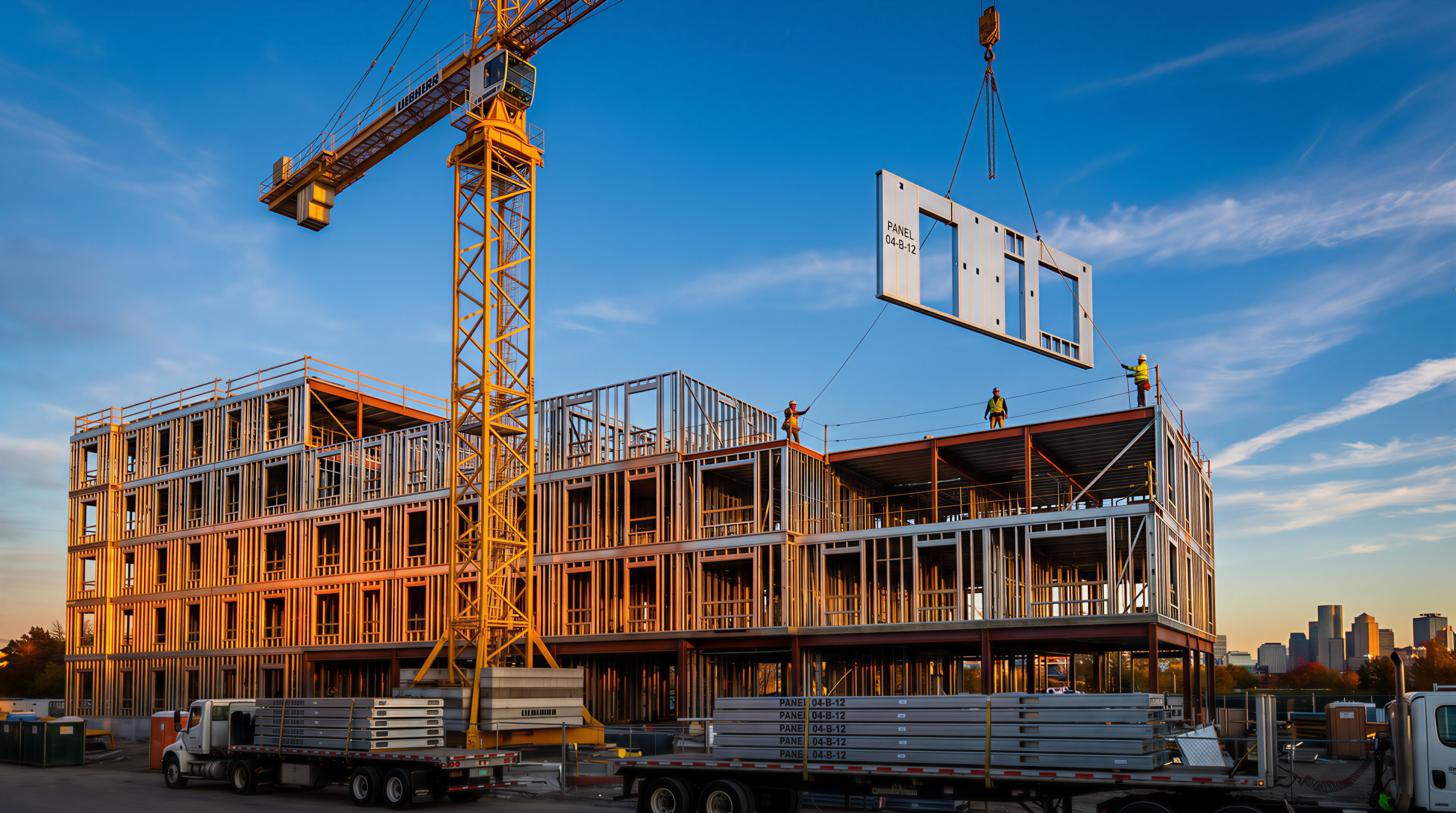
The Fastest Way to Frame a Multifamily Building: Prefabricated CFS Panels vs. Stick Framing
Direct Answer: How Much Faster Is Prefabricated CFS Framing?
"The fastest way to frame a multifamily building is with prefabricated cold-formed steel (CFS) panels: AAC Steel's panelized CFS system reduces on-site framing time by 35–55% compared to wood stick framing, because panels are fully fabricated at AAC Steel's Franklin, Massachusetts factory — with studs pre-punched, panels BIM-labeled, and MEP penetrations pre-cut — before a single crane pick occurs on site."
For Massachusetts multifamily developers building 4–8 story R-2 occupancy projects, framing schedule is not an abstract construction metric — it is a lender conversation. Every week the structural frame sits incomplete is a week of interest carry, a week closer to the November weather window, and a week of framing subcontractor cost exposure in one of the tightest skilled-labor markets in New England. The schedule math matters in dollars, not just days.
This article presents fabrication-to-installation workflow data drawn directly from AAC Steel's Massachusetts project operations — the only source that can simultaneously cite a Franklin, MA factory, Massachusetts labor market conditions, and 780 CMR code compliance in the same schedule analysis. No industry association estimate. No national average. No out-of-state fabricator's assumptions about New England winters.
The Benchmark: 10–14 Weeks vs. 18–24 Weeks for a 6-Story Massachusetts Building
"For a 6-story, 120,000 SF multifamily building in Massachusetts, AAC Steel's CFS panel system completes structural framing in 10–14 weeks; a comparable wood stick-frame project under New England labor and weather conditions typically requires 18–24 weeks — a schedule gap that can determine whether a developer closes the building before winter or loses an entire construction season."
That 8–14 week gap is not a marketing claim — it is the compounded result of six discrete schedule advantages that prefabricated CFS panels hold over wood stick framing. Each advantage is quantifiable. Together, they explain why Massachusetts developers and general contractors who have built once with AAC Steel's panel system do not return to stick framing for 4-story-and-above multifamily work.
To anchor the carry-cost reality: on a $30 million construction loan at a 7.5% interest rate, each week of extended framing schedule costs approximately $43,000 in interest carry. An 8-week framing schedule recovery — the conservative end of AAC Steel's documented range — represents roughly $345,000 in avoided carry cost before accounting for winter protection expenses, labor inefficiency, or trade re-sequencing delays. Developers reviewing this article with their lender or CFO should use their own project's interest rate and loan amount; the structural argument does not change regardless of the rate assumption.
Why Prefabricated CFS Panels Are Faster: The Six Schedule Drivers
1. Parallel Workflow: Fabrication Runs While the Foundation Is Still Being Poured
The most significant single source of schedule recovery in a CFS panel system is not installation speed — it is the elimination of the sequential bottleneck that governs every stick-frame project. In a conventional wood or field-cut steel stick-frame schedule, framing cannot begin until the foundation is complete, inspected, and released. That sequencing means any foundation delay — weather, concrete cure time, inspection backlog — is a direct framing delay with no recovery path.
AAC Steel's system breaks that dependency entirely. BIM coordination begins at contract execution. Panel fabrication begins at foundation permit — not foundation completion. When the slab is ready, the panels are ready. First crane pick occurs within 48 hours of slab readiness, because the panels have already been fabricated, quality-inspected, and staged for just-in-time delivery from Franklin, MA.
A stick-frame project cannot begin fabrication until the foundation is released — meaning every week of foundation delay is a week of framing delay compounded. With AAC Steel's system, the two schedules run in parallel: BIM coordination begins at contract execution, panel fabrication begins at foundation permit, and first crane pick occurs within 48 hours of slab readiness. On a 6-story project, this parallel workflow alone recovers 4–6 weeks on the critical path before a single panel is installed.
Your framing schedule is a financial decision. Schedule a 30-minute project review with AAC Steel's engineering team — we'll deliver a week-by-week panel schedule you can attach to your construction loan draw request. Submit your project at aacsteel.com/schedule.
2. Zero Field Cutting, Zero Coordination Lag
Every stud in an AAC Steel panel arrives at the site pre-cut to dimension, pre-punched for MEP penetrations, and labeled for crane placement to a specific floor and grid location. The on-site crew does not measure, does not cut, and does not wait for MEP coordination drawings to catch up to the framing crew. The LOD 400 BIM model that AAC Steel produces for every project resolves those conflicts digitally — in the factory — before fabrication begins.
In a wood stick-frame or field-cut steel schedule, MEP coordination lag is one of the most consistent sources of unplanned delay. Field crews discover conflicts between framing members and mechanical runs, framing stops while the GC waits for RFI responses, and the sequence of rough-in trades re-stacks. AAC Steel's LOD 400 coordination standard eliminates the field coordination cycle that adds 2–4 weeks to wood or field-cut steel schedules on a 5–7 story building.chedules on a 5–7 story building.
3. On-Site Crew Reduction
AAC Steel panelized systems require 35–40% fewer on-site framing workers versus stick framing. On a typical 120,000 SF project, this reduction translates directly to hundreds of crew-weeks saved. In Massachusetts, where framing subcontractor availability regularly delays project starts by 3–6 weeks, reducing the crew requirement means a developer can source framing labor more reliably, start sooner, and avoid the subcontractor availability penalty that is a documented baseline risk on Boston-area wood-frame multifamily projects.
4. Weather Independence
Because AAC Steel fabricates panels in a controlled factory environment in Franklin, MA, panel production is not subject to New England winter shutdowns. Massachusetts outdoor framing conditions are viable for approximately 7–8 months per year. From November through March, wood framing in New England faces cold-weather concrete requirements, mandatory temporary heat enclosures, and moisture-protection requirements that slow installation. A CFS panel building can continue framing through these winter conditions, protecting the interior finish schedule from winter delay.
5. Trade Sequencing Acceleration
With prefabricated CFS panels, MEP, insulation, and drywall can begin floor-by-floor as panels are set — not after full structural completion. This parallel trade sequencing accelerates the overall project timeline, recovering weeks of schedule that would otherwise be lost waiting for the entire frame to be finished before rough-ins can commence.
6. Inspection and Close-In Speed
Non-combustible CFS eliminates the fire-watch and temporary protection requirements that 780 CMR imposes on combustible framing in occupied-adjacent structures. Cold-formed steel is not subject to the moisture-protection requirements that govern wood framing in cold weather, meaning a CFS panel building can continue framing through Massachusetts winter conditions that would require a wood-frame crew to stop, tent, heat, and re-inspect before proceeding.
Schedule Comparison Table: CFS Panels vs. Wood Stick Framing
| Schedule Milestone | AAC Steel CFS Panel System | Wood Stick Framing (MA Baseline) | Schedule Delta |
|---|---|---|---|
| BIM coordination / submittals | Concurrent with civil/foundation work | Begins after foundation release | +4–6 weeks recovered |
| Concrete podium requirement | Not required (Type IIB non-combustible) | Required for wood-over-concrete hybrid | +4–8 weeks recovered |
| Panel/material fabrication lead time | 6–8 weeks (runs parallel to foundation) | No pre-fabrication; material staged on-site | Parallel workflow; no net delay |
| On-site framing, 6 stories / 120,000 SF | 10–14 weeks | 18–24 weeks (NE labor and weather) | 8–14 weeks recovered |
| MEP rough-in coordination delays | Eliminated (LOD 400 pre-punched) | 2–4 weeks field coordination lag | +2–4 weeks recovered |
| Winter weather framing stoppages | Minimal — CFS not moisture-sensitive | 4–8 weeks unplanned (Oct–Apr exposure) | +4–8 weeks risk eliminated |
| Wood shrinkage callbacks | None — steel does not shrink | 2–4 weeks re-work post-occupancy | Post-occupancy risk eliminated |
| Framing crew size required | 35–40% fewer on-site workers | Full stick-frame crew (harder to source in MA) | 3–6 week subcontractor delay de-risked |
AAC Steel Massachusetts Project Portfolio Data
Across AAC Steel's Massachusetts project portfolio, average structural framing duration for 5–7 story R-2 buildings has been 11–14 weeks, versus GC-estimated wood baselines of 19–25 weeks on the same sites. The schedule recovery has been consistent across urban infill sites in Greater Boston, suburban mid-rise developments on the South Shore, and mixed-use R-2 projects in Central Massachusetts — each of which presented different foundation conditions, site access constraints, and winter weather exposure windows.
In one representative 6-story, R-2 occupancy project in Eastern Massachusetts, the project team's pre-bid schedule model assumed 22 weeks for wood stick framing under Massachusetts winter conditions. AAC Steel's CFS panel system completed structural framing in 12 weeks from first crane pick. The 10-week schedule recovery eliminated one full construction loan draw period and closed the building before the November weather window — avoiding an estimated $60,000–$90,000 in temporary heat and weather protection costs that the GC had budgeted for a wood-frame winter close-in sequence. The GC reduced its on-site framing crew by 38% versus their wood-frame baseline, resolving a subcontractor availability constraint that had been flagged as a critical-path risk at project kickoff.
The AAC Steel Workflow: From Contract Execution to Final Panel Pick
Week 1–2: BIM Coordination Begins at Contract Execution
AAC Steel's engineering team initiates LOD 400 BIM modeling immediately upon contract execution — not upon foundation completion, not upon GC mobilization. Architectural and structural drawings are incorporated into the panel model, MEP rough-in routing is coordinated and confirmed with the MEP engineer of record, and the panel system is fully clash-resolved before fabrication begins. This phase runs concurrent with civil work, site preparation, and foundation construction.
Week 3–8: Factory Fabrication Runs Parallel to Foundation Work
Panel fabrication at AAC Steel's Franklin, MA facility begins upon foundation permit issuance — the earliest defensible trigger point for committing steel. Panels are cut, punched, assembled, quality-inspected, and staged for delivery in the sequence dictated by the crane pick schedule. Every panel ships with a signed fabrication package traceable to ASTM C955, AISI S100-16, and the project's 780 CMR submission — enabling engineer-of-record approval without field testing delays.
Week 8–10: Just-in-Time Delivery Keyed to the Crane Schedule
AAC Steel coordinates panel delivery from Franklin, MA on a just-in-time basis — panels arrive at the site in crane-pick sequence, staged to minimize laydown area and eliminate rehandling. Because the factory is in Massachusetts, delivery lead times are measured in hours, not days. If a site condition requires a same-day engineering decision, AAC Steel's team can be on-site the same afternoon.
Week 8–22: On-Site Installation at CFS Panel Speed
On-site installation requires a smaller, more specialized crew than wood stick framing. Panels are crane-picked from the delivery truck, set to layout lines established from the BIM model, plumbed, and fastened. No field cutting. No MEP coordination holds. No moisture protection requirements. A single floor of a 6-story, 120,000 SF building — approximately 20,000 SF per floor — can be framed and ready for the next trade in days, not weeks.
AAC Steel: Massachusetts-Based, Engineer-Stamped, Code-Compliant
AAC Steel is the only cold-formed steel panel fabricator based in Massachusetts. Our Franklin, MA factory serves multifamily developers and general contractors across New England with engineer-stamped, BIM-coordinated CFS panel systems for 4–8 story R-2 occupancy buildings. Every panel ships with a signed fabrication package traceable to ASTM C955, AISI S100-16, and the project's 780 CMR submission.
Factory lead times are currently 6–8 weeks. Massachusetts multifamily projects in pre-development or early design should reserve fabrication capacity now to protect the framing start date on the critical path. Once a fabrication slot is reserved, AAC Steel's engineering team begins BIM coordination immediately — at no additional mobilization cost — so that the parallel workflow advantage is fully realized from day one of foundation construction.
Your framing schedule is a lender conversation, not just a construction decision. In 30 minutes, AAC Steel's engineering team will map your project — floor count, square footage, site address — to a week-by-week panel delivery schedule you can submit with your next draw request.
Download AAC Steel's CFS Panel Schedule Comparison — a side-by-side timeline showing a 6-story, 100-unit Massachusetts multifamily project framed in CFS panels versus wood stick, with critical-path milestones, winter weather buffers, and delivery lead times mapped by floor. Or contact AAC Steel directly to receive a preliminary panel schedule for your current project site.
Massachusetts projects only. Submit at aacsteel.com/schedule or contact Carlos Ferreira directly. Factory lead times are currently 6–8 weeks — projects in pre-development should reserve now.
Frequently Asked Questions
What is the fastest way to frame a multifamily building?
AAC Steel's prefabricated CFS panel system is the fastest structural framing method for multifamily buildings in Massachusetts — completing a 6-story, 120,000 SF R-2 building in 10–14 weeks versus 18–24 weeks for wood stick framing under New England labor and weather conditions.
How much faster is CFS panel framing than wood stick framing?
AAC Steel's panelized CFS system reduces on-site framing time by 35–55% compared to wood stick framing, with the largest schedule gains coming from parallel fabrication-to-foundation workflow and zero field cutting.
How much does a faster framing schedule save a developer?
On a $30 million construction loan at 7.5% interest, each week of framing schedule recovery saves approximately $43,000 in interest carry. AAC Steel's documented 8–14 week framing advantage over stick framing represents $345,000–$602,000 in avoided carry cost on a project of that size.
Who manufactures prefabricated CFS panels for multifamily construction in Massachusetts?
AAC Steel, based in Franklin, Massachusetts, is the only CFS panel fabricator in New England serving the 4–8 story multifamily market. Panels are fabricated at the Franklin facility and delivered just-in-time to job sites across Massachusetts and New England.
Does prefabricated CFS framing work for winter construction in New England?
Yes. Because AAC Steel fabricates panels in a controlled factory environment in Franklin, MA, panel production is not subject to New England winter conditions. On-site installation is significantly faster than wood stick framing, reducing weather exposure risk during the November–March high-risk window.