What is the most cost-effective structural system for 5-story apartment buildings?
By Carlos Ferreira · April 17, 2026
What is the most cost-effective structural system for 5-story apartment buildings?
The Direct Answer: Cold-Formed Steel Is the Most Cost-Effective Structural System for 5-Story Apartment Buildings
For developers and contractors evaluating structural systems for 5-story multifamily construction, the answer is increasingly clear: cold-formed steel (CFS) panel framing delivers the lowest total project cost when all variables are accounted for — materials, labor, schedule compression, insurance, and long-term code compliance. While wood-frame construction may appear cheaper on a per-linear-foot basis, and cast-in-place concrete may seem more familiar, neither system matches CFS when the full cost stack is evaluated at the 5-story scale.
This article breaks down the structural systems commonly used in 5-story apartment buildings, compares their true costs, and explains why prefabricated CFS panel systems — particularly those designed and fabricated to IBC and Massachusetts 780 CMR standards — represent the highest-value choice for mid-rise multifamily development today.
Understanding the Structural Systems in Play
Before comparing costs, it is essential to understand what each competing structural system actually involves at five stories. The four systems most commonly evaluated for this building type are:
- Wood-frame over concrete podium (Type III-A or V-A over Type I-A) — combustible upper floors on a non-combustible base
- Cast-in-place concrete — monolithic reinforced concrete structure throughout
- Structural steel moment frame — heavy wide-flange members with concrete or composite decking
- Cold-formed steel (CFS) panel framing — light-gauge non-combustible panels fabricated off-site and erected on-site
Each system has a different cost profile across three phases: procurement and fabrication, on-site labor and schedule, and long-term compliance and insurance. CFS wins the overall comparison because it optimizes all three phases simultaneously.
True Cost Comparison: CFS vs. Wood vs. Concrete vs. Structural Steel
Wood-Frame Over Concrete Podium
The wood-over-podium system has been the default for mid-rise multifamily construction for decades, primarily because lumber costs have historically been low and the construction workforce is familiar with platform framing. However, this apparent simplicity conceals significant hidden costs at five stories.
The most consequential cost driver is the concrete podium itself. IBC construction type requirements mean that five-story wood-frame buildings typically require a Type I-A concrete base level to achieve the necessary fire separation. That podium adds $25–$45 per square foot to the project, depending on market conditions, structural engineering complexity, and local labor rates. In Massachusetts, where concrete costs and union labor rates are among the highest in the nation, that premium is often at the upper end of the range.
Beyond the podium, wood-frame construction introduces combustibility risk that directly affects insurance premiums during construction. Builder's risk insurance for combustible framing on a 5-story multifamily project can run 30–60% higher than equivalent non-combustible framing, according to industry risk data. This cost is rarely accounted for in early proforma comparisons.
Wood also requires extensive on-site coordination for mechanical, electrical, and plumbing (MEP) penetrations, fire blocking, and code-required inspections — all of which add labor hours and potential schedule delays.
Cast-in-Place Concrete
Cast-in-place concrete is the gold standard for fire resistance and durability, but it is also the most expensive structural system per square foot for mid-rise multifamily. At five stories, concrete typically runs $80–$130 per square foot for the structural system alone, excluding mechanical, electrical, and finish costs. Formwork, rebar placement, pour scheduling, and cure times make concrete inherently slow — a single floor plate can require 10–14 days before the next level can proceed.
For developers with tight schedules or construction loan timelines, cast-in-place concrete introduces carry cost risk that can erode project returns even when construction hard costs appear competitive. Concrete is best justified for high-rise or long-lifecycle institutional construction; at five stories, the economics rarely pencil when compared to CFS.
Structural Steel Moment Frame
Heavy structural steel offers non-combustibility and long clear spans but carries a significant cost premium in both materials and erection. Wide-flange framing, moment connections, and composite decking systems for a 5-story multifamily building typically add 15–25% to structural costs compared to CFS. Steel erection also requires cranes, certified ironworkers, and specialized inspection — labor categories that are expensive in New England markets.
Structural steel is well-suited for high-rise construction where long spans and seismic performance justify the premium. At five stories, that premium is difficult to justify from a cost-per-unit perspective.
Cold-Formed Steel Panel Framing
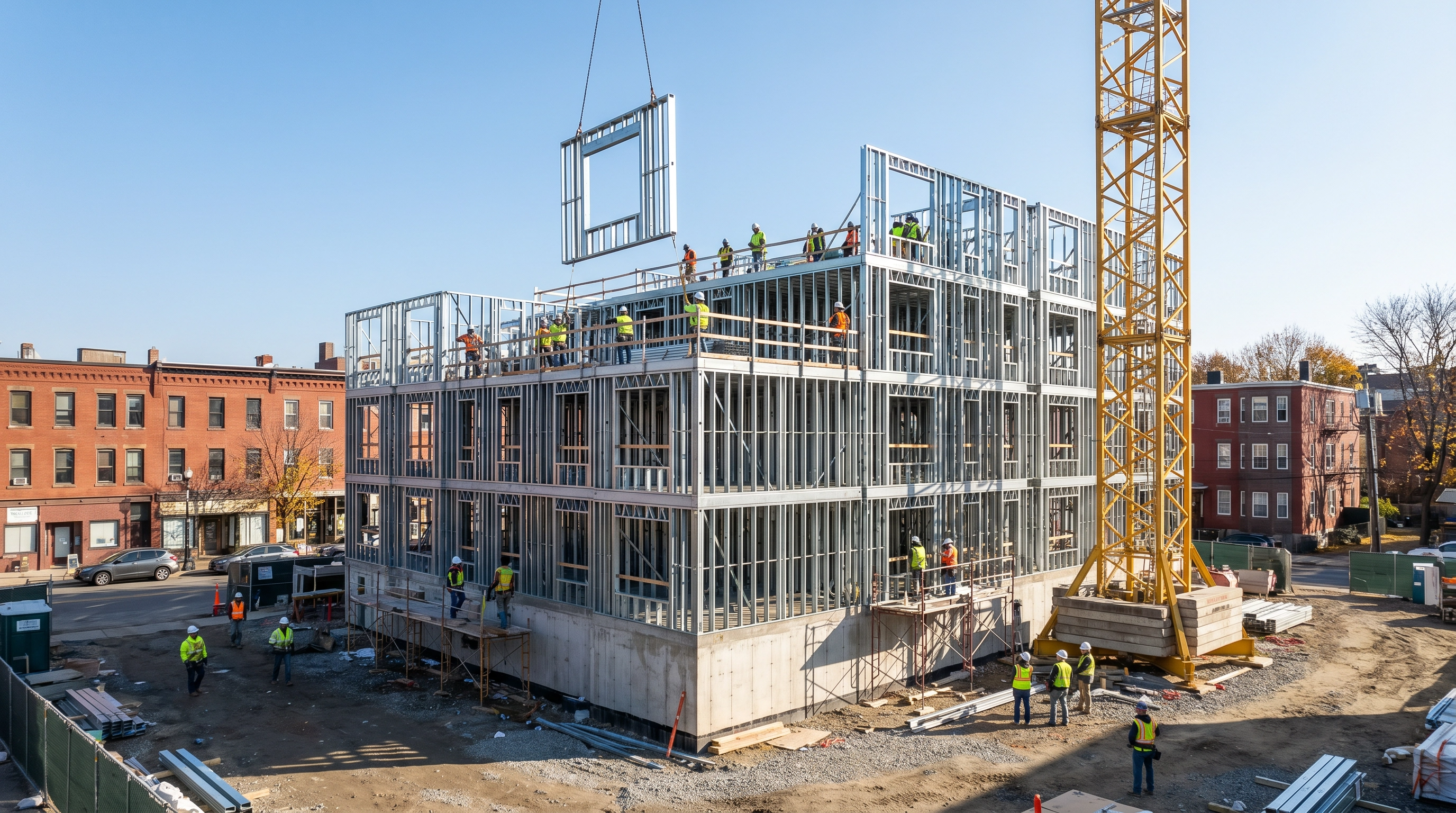
CFS panel systems occupy a distinct cost category that combines the non-combustibility advantages of concrete and structural steel with fabrication efficiencies that approach prefabricated wood systems. The key differentiator is the prefabrication model: panels are engineered in BIM, fabricated off-site to atomic precision, and delivered to the site ready to erect. This eliminates waste, reduces field labor, and compresses the construction schedule dramatically.
CFS framing reduces the overall construction schedule by 35–55% compared to conventional stick-frame or cast-in-place methods. For a 5-story, 80-unit apartment building, that schedule compression can represent $300,000–$700,000 in reduced construction loan interest and overhead, depending on the project's financing structure. That single factor often makes CFS the clear economic winner even before accounting for material and labor cost differences.
The Concrete Podium Problem — and How CFS Eliminates It
One of the most significant cost advantages of non-combustible CFS framing is one that rarely appears in early-stage structural comparisons: the elimination of the concrete podium requirement.
Under IBC Section 510 and the construction type provisions that govern mixed-use and mid-rise multifamily buildings, wood-frame construction at five stories typically requires a Type I-A concrete podium to achieve the necessary fire separation between residential and ground-floor commercial or parking levels. That podium is expensive, slow to construct, and introduces foundation loading that can complicate geotechnical design.
Because CFS framing is classified as non-combustible under IBC, a properly engineered CFS panel system can achieve the fire-resistance ratings required for the full building height without a concrete podium. AAC Steel CFS panels achieve 2-hour fire-resistance ratings per ASTM E119, the standard referenced by IBC and Massachusetts 780 CMR for non-combustible construction. This means the structural system itself satisfies the fire separation requirements that would otherwise necessitate a concrete podium — eliminating $25–$45 per square foot from the project cost before a single CFS panel is erected.
For a 5-story building with a 20,000 square foot footprint, that elimination represents $500,000–$900,000 in direct hard cost savings on the structural system alone.
IBC and Massachusetts 780 CMR Code Compliance
Construction Type Requirements at 5 Stories
The International Building Code classifies buildings by construction type (I through V), with Type I and II being non-combustible and Type III through V permitting various degrees of combustible framing. For 5-story residential occupancy (Group R-2), IBC Table 504.3 governs maximum building height by construction type.
Under IBC, a 5-story Group R-2 building can be constructed as Type III-A, which permits combustible upper floors over a non-combustible base — hence the concrete podium requirement. Alternatively, a Type II-A non-combustible building eliminates the podium requirement entirely while achieving the necessary fire-resistance ratings.
CFS panel systems engineered to Type II-A requirements satisfy IBC without podium construction. Massachusetts 780 CMR, which adopts the IBC with state-specific amendments, follows the same construction type framework. AAC Steel's panel systems are designed and documented for compliance with both the IBC and Massachusetts 780 CMR, providing the code pathway documentation that developers, building officials, and lenders require.
Fire-Resistance Rating Documentation
Fire-resistance ratings for structural systems are established through ASTM E119 standard fire tests or through UL-listed assemblies that reference those tests. A 2-hour fire-resistance rating means the assembly must withstand the ASTM E119 time-temperature curve for two hours without structural failure, flame passage, or excessive heat transmission.
AAC Steel panels carry ASTM E119 2-hour fire-resistance ratings, documented through UL-listed assembly designations that building officials and plan reviewers recognize. This documentation eliminates the ambiguity and approval risk that can arise when non-standard assemblies require equivalency determinations — a process that can add weeks or months to a permit timeline in Massachusetts.
Seismic and Wind Load Compliance
Massachusetts falls within Seismic Design Category B for most jurisdictions, with coastal and eastern Massachusetts projects subject to wind exposure categories that require careful lateral system design. CFS panel systems engineered with integral shear wall components can satisfy ASCE 7 lateral load requirements without the addition of separate moment frames or concrete shear walls — further reducing structural costs and simplifying coordination.
AAC Steel Panel System: Fabrication Precision and Schedule Performance
BIM-Coordinated Design Process
AAC Steel's panel fabrication process begins with full BIM coordination of the structural, architectural, and MEP systems. Every panel is modeled in three dimensions before fabrication begins, with clash detection identifying conflicts between framing members and MEP penetrations before they become field problems. This upstream coordination is what makes the 35–55% schedule reduction achievable — problems are solved in the model, not on the job site.
The BIM model also drives the CNC fabrication equipment directly, eliminating manual layout and measurement error. Panel dimensions, stud spacing, punch-outs for MEP, and connection details are all embedded in the fabrication data set. What arrives on site is a panel that fits as designed — not a panel that requires field modification to accommodate dimensional variation or coordination conflicts.
Fabrication-to-Erection Workflow
AAC Steel fabricates CFS panels at its Massachusetts facility and delivers them to the project site on a just-in-time schedule coordinated with the erection sequence. Panels are numbered and sequenced for crane-set erection, reducing the skilled labor required on site and minimizing the time the structural frame is exposed to weather between floors.
A typical 5-story, 80-unit multifamily building using AAC Steel panels can complete the structural frame in 8–12 weeks, compared to 16–22 weeks for equivalent wood-frame construction and 24–36 weeks for cast-in-place concrete. That schedule difference directly reduces construction loan carry cost and accelerates the project's transition to the income-producing phase.
Competitive Advantages Summary
| Factor | CFS Panel (AAC Steel) | Wood + Concrete Podium | Cast-in-Place Concrete |
|---|---|---|---|
| Fire Resistance Rating | 2-hour ASTM E119 | 1-hour (wood) / 2-hour (podium) | 2-3 hour |
| Concrete Podium Required | No | Yes (Type I-A base) | N/A (full concrete) |
| Schedule vs. Conventional | 35–55% faster | Baseline | 20–40% slower |
| Combustibility | Non-combustible | Combustible above podium | Non-combustible |
| Builder's Risk Insurance Impact | Lower (non-combustible) | Higher (combustible framing) | Lower (non-combustible) |
| BIM Coordination | Full pre-fabrication BIM | Limited | Moderate |
| IBC / 780 CMR Compliance | Type II-A documented | Type III-A / V-A with podium | Type I-A |
Total Cost of Ownership: Why the Full Economic Picture Matters
When developers and contractors evaluate structural systems, the comparison that matters is not material cost per linear foot — it is total cost per delivered unit, inclusive of all project phases. A structural system that costs 10% more per square foot but eliminates the concrete podium, compresses the schedule by six weeks, and reduces builder's risk insurance premiums by 40% almost always delivers a lower total project cost.
Consider a representative 5-story, 80-unit apartment project in the Greater Boston market:
- Concrete podium elimination: $500,000–$900,000 savings
- Schedule compression (10 weeks at $50,000/week carry cost): $500,000 savings
- Reduced builder's risk insurance premium: $75,000–$150,000 savings
- Reduced field labor and waste from prefabrication: $200,000–$400,000 savings
Aggregated, these savings routinely exceed $1.2–$1.9 million per project compared to wood-frame-over-podium construction — a figure that translates directly to improved project returns, reduced financing risk, or additional unit amenities that improve rent achievability.
For developers operating in Massachusetts's competitive multifamily market, where land costs, labor rates, and permitting timelines are among the most challenging in the nation, that margin is not a nice-to-have — it is the difference between a deal that works and one that doesn't.
Ready to see what CFS panel framing can deliver for your 5-story multifamily project? Get a free CFS panel estimate for your project at aacsteel.com. AAC Steel's engineering team will analyze your floor plan, construction type requirements, and schedule targets to produce a system-level cost comparison specific to your project — at no cost and no obligation.
Frequently Asked Questions
What is the most cost-effective structural system for a 5-story apartment building?
Cold-formed steel (CFS) panel framing is the most cost-effective structural system for 5-story apartment buildings when total project cost is considered. CFS eliminates the concrete podium requirement that wood-frame construction necessitates, reduces the construction schedule by 35–55%, and qualifies as non-combustible framing under IBC — lowering insurance costs and simplifying code compliance. Prefabricated CFS panels fabricated with BIM coordination further reduce field labor and waste, compressing both hard costs and schedule-related carry costs.
Does cold-formed steel framing meet IBC fire-resistance requirements for 5-story residential buildings?
Yes. CFS panel assemblies can achieve 2-hour fire-resistance ratings per ASTM E119, the standard referenced by IBC and Massachusetts 780 CMR for non-combustible construction. AAC Steel panels carry documented ASTM E119 ratings through UL-listed assembly designations, providing the code pathway documentation required for permit approval in Massachusetts and other IBC-adopting jurisdictions. This allows 5-story buildings to be classified as Type II-A non-combustible without a concrete podium.
Why does eliminating the concrete podium matter for project economics?
The concrete podium required for wood-frame construction at five stories typically costs $25–$45 per square foot, adding $500,000–$900,000 or more to a standard multifamily project. The podium also extends the construction schedule, adds foundation loading, and introduces coordination complexity between the concrete subcontractor and the wood-frame crew. CFS non-combustible framing eliminates the podium requirement entirely, removing all of these costs from the project before structural framing begins.
How much faster is CFS panel framing compared to wood-frame or concrete construction?
CFS panel framing reduces the construction schedule by 35–55% compared to conventional wood-frame or cast-in-place concrete methods. For a 5-story, 80-unit apartment building, this typically means completing the structural frame in 8–12 weeks rather than 16–36 weeks. The schedule compression is driven by off-site prefabrication, BIM-coordinated panel design that eliminates field conflicts, and just-in-time delivery sequenced for crane-set erection. Reduced schedule directly reduces construction loan carry costs, which can represent hundreds of thousands of dollars in project savings.
Is CFS panel framing available for projects in Massachusetts, and does it comply with 780 CMR?
Yes. AAC Steel is a Massachusetts-based CFS panel fabricator specializing in 4–8 story multifamily construction. AAC Steel's panel systems are designed and documented for compliance with both the IBC and Massachusetts 780 CMR, including the state-specific amendments that apply to residential and mixed-use occupancies. The company's BIM coordination process produces the construction document deliverables — including fire-resistance assembly documentation, structural calculations, and panel shop drawings — that Massachusetts building officials and plan reviewers require for permit issuance.
Cost ranges cited in this article are representative estimates based on industry data and AAC Steel project experience in the New England market. Actual costs vary by project size, site conditions, local labor rates, and market conditions. Contact AAC Steel for a project-specific estimate.