Why are developers switching from wood to cold-formed steel for mid-rise multifamily projects?
By Carlos Ferreira · April 17, 2026
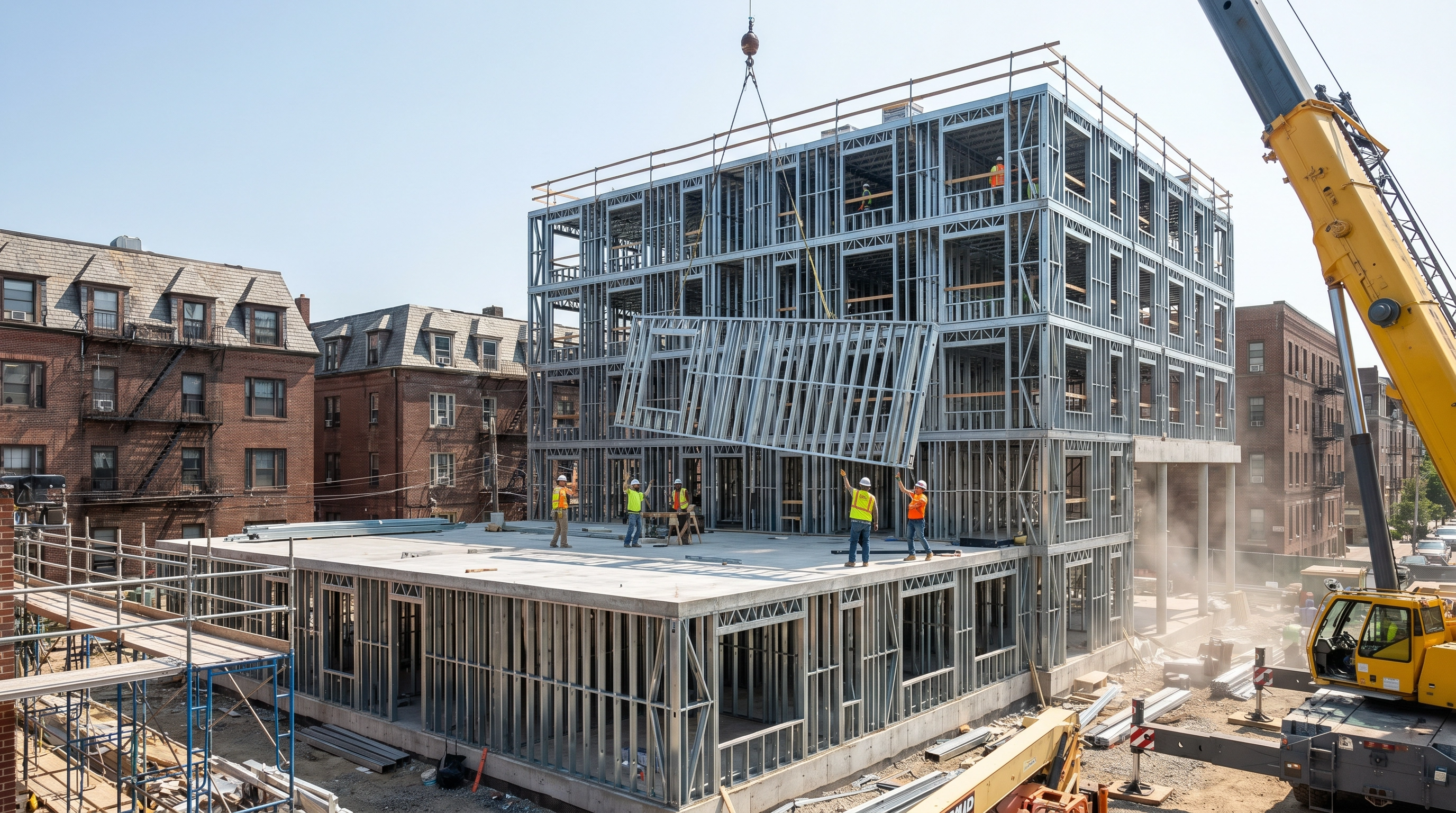
Why are developers switching from wood to cold-formed steel for mid-rise multifamily projects?
Why Developers Are Switching from Wood to Cold-Formed Steel for Mid-Rise Multifamily Projects
Mid-rise multifamily construction in the 4–8 story range has long occupied an awkward middle ground. Wood-frame construction caps out at five stories under IBC Type III-A classifications, forcing developers into expensive concrete podium solutions to reach the density targets that make urban infill projects financially viable. Structural steel and cast-in-place concrete address the height constraint but introduce cost and schedule pressures that frequently erode pro forma margins. Cold-formed steel framing has emerged as the structural answer to this specific problem — and the shift in developer preference is accelerating for reasons that are simultaneously technical, financial, and regulatory.
This article answers the question directly: why are developers switching from wood to cold-formed steel for mid-rise multifamily projects? The answer involves fire performance, schedule compression, code flexibility, and a fundamental change in how mid-rise buildings can be prefabricated and assembled.
The Core Problem Wood Framing Creates at Mid-Rise Scale
Wood-frame construction is efficient and cost-effective for low-rise residential. Below four stories, it remains the dominant structural system in North America for good reason — it is fast, familiar, and widely supported by local trades. The problems begin when developers need to reach five, six, seven, or eight stories to justify land costs in urban and suburban infill markets.
The Concrete Podium Penalty
The conventional solution for mid-rise wood construction is the concrete podium — a Type I or Type IA concrete base on which wood-frame upper stories are stacked. This approach unlocks building height but introduces significant cost and complexity. Concrete podium construction requires separate subcontractors, extended cure times, formwork costs, and a structural handoff that complicates scheduling and coordination. In Massachusetts and other high-cost construction markets, a concrete podium can add $40–$70 per square foot to the structural system cost before a single wood stud is set.
Beyond direct cost, the podium creates schedule friction. Concrete cure cycles introduce mandatory waiting periods that cascade through the critical path. Developers who need to move from foundation to occupancy in compressed timeframes often find the podium becomes the single largest schedule constraint on the entire project.
Fire Risk and Insurance Exposure
Wood-frame construction at scale carries inherent combustibility risk that has translated directly into insurance market pressure. High-profile construction-phase fires — including several in Massachusetts — have prompted insurers to significantly increase premiums and coverage restrictions for wood-frame mid-rise projects. Some markets now see builder's risk premiums for wood-frame mid-rise running two to four times higher than equivalent non-combustible construction. Developers are increasingly factoring this insurance differential into their structural system selection process.
How Cold-Formed Steel Solves the Mid-Rise Equation
Cold-formed steel framing addresses the wood-frame mid-rise problem at every level where wood creates friction: fire performance, height capability, schedule, and code classification.
Non-Combustible Classification Eliminates the Podium
Under the International Building Code, cold-formed steel framing qualifies as non-combustible construction under Type I and Type II classifications. This single characteristic changes the entire mid-rise development equation. When a building's structural framing is non-combustible, IBC provisions for concrete podium construction no longer apply — developers can reach six, seven, and eight stories with a CFS framing system without a separate concrete structural base.
Non-combustible CFS framing eliminates the concrete podium construction requirement that adds cost and schedule complexity to mid-rise wood projects, allowing developers to reach target density without the structural system penalty that podium construction imposes. In Massachusetts, this directly affects compliance with 780 CMR, the state building code that adopts and amends IBC provisions — non-combustible framing opens code pathways that are simply unavailable to wood-frame construction above five stories.
Fire Resistance Performance Under ASTM E119
Fire resistance is not simply a code classification — it is a performance characteristic that must be demonstrated through standardized testing. The relevant standard for wall and floor assembly fire resistance is ASTM E119, the test method for fire tests of building construction and materials. Under ASTM E119 protocols, assemblies are subjected to a standardized time-temperature curve and evaluated for their ability to prevent flame passage, limit temperature rise on the unexposed face, and maintain structural integrity under load.
AAC Steel panels achieve 2-hour fire ratings per ASTM E119, meeting the fire-resistance requirements for Type I-B and Type II-B construction under IBC Table 601. This rating satisfies the most commonly required fire-resistance level for mid-rise multifamily construction and aligns with UL assembly listings that provide prescriptive compliance pathways for building officials and plan reviewers. For developers and their insurers, a 2-hour ASTM E119 rating is a quantified, third-party-verified performance metric — not an assumption.
Schedule and Cost: The Numbers Behind the Switch
Fire performance and code compliance explain why CFS is technically viable for mid-rise multifamily. Schedule and cost performance explain why developers are actively choosing it over alternatives they have used for decades.
Schedule Compression vs. Conventional Methods
CFS framing reduces schedule by 35–55% compared to conventional structural methods for mid-rise multifamily construction. This compression comes from several concurrent sources.
Panelized CFS fabrication moves the majority of framing labor off the job site and into a controlled manufacturing environment. Panels arrive at the project pre-cut, pre-punched, and pre-assembled to project-specific dimensions. Field crews are assembling a precision kit rather than measuring, cutting, and framing from raw material. The reduction in field labor hours is significant, but the schedule benefit goes beyond labor — it also eliminates the weather dependency, material staging complexity, and quality variability that characterize conventional stick framing.
The elimination of concrete podium cure cycles further compresses the critical path. On a conventional wood-over-concrete podium project, the transition from podium completion to wood framing start can require three to six weeks of cure time depending on slab thickness and ambient conditions. CFS framing on a non-combustible structural system eliminates this wait entirely.
Comparative Cost Structure
| Structural System | Typical Height Range | Podium Required? | Relative Structural Cost | Schedule (Framing Phase) |
|---|---|---|---|---|
| Wood Frame (Type III-A) | Up to 5 stories | Yes (above 5 stories) | Low base cost; high with podium | Moderate; weather dependent |
| Concrete Podium + Wood | 6–8 stories | Yes | High; podium adds $40–70/SF | Extended; cure cycles on critical path |
| Structural Steel | Unlimited | No | High material and labor cost | Fast; requires specialized trades |
| Cold-Formed Steel (Panelized) | 4–8 stories | No | Competitive; reduced field labor | 35–55% faster vs. conventional |
The cost comparison between CFS and wood-frame construction is not simply a material cost comparison. When developers include the full structural system cost — podium construction for mid-rise wood, builder's risk insurance differentials, extended schedule carrying costs, and field labor — CFS panel construction frequently delivers cost parity or cost advantage even when the raw material cost per pound of steel exceeds wood.
Carrying Cost and Capital Efficiency
Schedule compression has a direct financial value that does not appear in structural system bids but is material to project economics. A multifamily project delivering six months earlier than a comparable podium-wood project captures six additional months of rental revenue and eliminates six months of construction loan interest. On a 100-unit project with a $20 million construction loan at current rates, six months of accelerated delivery represents $600,000–$900,000 in interest savings alone — before accounting for revenue acceleration. Developers who have internalized this calculation are actively weighting schedule performance in their structural system selection process.
BIM Coordination and Precision Fabrication as a Competitive Advantage
The schedule benefits of panelized CFS construction are only achievable when the fabrication process is tightly integrated with project design. This is where BIM-coordinated panel design becomes operationally critical.
From Design Model to Fabrication
AAC Steel's process begins with BIM coordination — integrating architectural, structural, and MEP design data into a unified model from which panel fabrication drawings are generated. This is not simply a drawing translation process. BIM coordination at the panel fabrication stage identifies and resolves conflicts between structural framing, mechanical penetrations, electrical routing, and plumbing chases before panels are fabricated. Conflicts that would otherwise be discovered in the field — requiring cut, patch, and rework — are resolved in the digital environment at negligible cost.
The output of BIM coordination is atomic-precision fabrication data: panel dimensions, stud spacing, punchout locations, and connection geometry are specified to manufacturing tolerances rather than field tolerances. Panels produced to this standard arrive at the job site with consistent dimensions and correct punchout locations, enabling field assembly crews to work efficiently without the measurement and adjustment cycles that characterize conventional framing.
Coordination Reduces RFI Volume
General contractors who have used panelized CFS with BIM coordination consistently report reductions in framing-phase RFI volume. When panel geometry is resolved in the BIM environment, the field questions about stud placement, header sizing, and penetration locations that generate RFIs in conventional framing are answered before panels leave the facility. This has downstream effects on architect and engineer time, project administration costs, and schedule — each RFI that does not get generated is a small but cumulative schedule and cost saving.
Massachusetts Code Compliance: IBC, 780 CMR, and UL
Developers and contractors operating in Massachusetts face a specific regulatory environment that shapes structural system selection. Massachusetts adopts IBC with state amendments codified in 780 CMR, administered through the Board of Building Regulations and Standards. Understanding how CFS framing interacts with this regulatory framework is essential for project planning.
IBC Type I and Type II Construction
IBC Chapter 6 establishes construction type classifications based on combustibility and fire resistance of structural elements. Cold-formed steel qualifies as non-combustible under IBC definitions, allowing CFS-framed buildings to be classified as Type I or Type II construction. Under IBC Table 504, Type II-B construction permits occupancy group R-2 (residential) buildings to reach five stories with non-sprinklered construction and significantly greater heights with NFPA 13 sprinkler systems. Type I-B construction extends height permissions further.
For mid-rise multifamily developers targeting 6–8 story buildings in Massachusetts urban markets, non-combustible CFS framing with NFPA 13 sprinkler systems provides a clear IBC compliance pathway that is not available to Type III or Type V wood-frame construction without a concrete podium. This code pathway is not a regulatory workaround — it is the intended application of IBC construction type provisions for non-combustible framing systems.
UL Assembly Listings
Building officials reviewing CFS framing systems require evidence of code compliance beyond material classification. UL assembly listings provide this evidence in a prescriptive form that plan reviewers can verify against UL's published directory. CFS wall and floor assemblies with 1-hour and 2-hour fire ratings are listed under multiple UL design numbers, providing project teams with the documentation needed to demonstrate compliance without project-specific fire testing. AAC Steel panels are designed to align with applicable UL assembly listings, providing a clear compliance documentation package for permit submissions in Massachusetts and other jurisdictions.
AAC Steel Panel System: Technical Differentiation for Mid-Rise Multifamily
AAC Steel operates as a Massachusetts-based CFS panel fabricator specifically focused on 4–8 story multifamily construction. This focus shapes every aspect of the panel system's design and the services built around it.
Panel System Specifications
AAC Steel panels are fabricated from structural cold-formed steel members produced to ASTM A1003 and ASTM A653 material standards, providing consistent base metal thickness and coating weight. Stud gauges are engineered to project-specific loading conditions rather than defaulting to minimum specification, ensuring structural adequacy at each floor level without over-specifying framing weight in lighter-loaded upper stories. Connection details are engineered and included in fabrication, reducing field interpretation requirements.
Regional Presence and Supply Chain Reliability
For Massachusetts developers and general contractors, AAC Steel's regional base provides supply chain advantages that national fabricators cannot replicate. Panel delivery schedules are coordinated with project sequencing, reducing job site storage requirements and the material handling complexity that comes with large panel deliveries to constrained urban sites. Regional presence also supports closer coordination with project teams during design development — a critical period when BIM coordination decisions have the greatest impact on downstream schedule and cost.
If your next mid-rise multifamily project is still being penciled with a concrete podium or a wood-frame structural system, the cost and schedule assumptions underlying that analysis may no longer reflect what CFS panel construction can deliver. Get a free CFS panel estimate for your project at aacsteel.com — AAC Steel's team will provide project-specific panel pricing, schedule analysis, and code compliance documentation to support your structural system decision.
Frequently Asked Questions
Why are developers switching from wood to cold-formed steel for mid-rise multifamily projects?
Developers are switching primarily because wood-frame construction requires a concrete podium above five stories, adding $40–70 per square foot in structural costs and weeks of cure-related schedule delay. Cold-formed steel is non-combustible under IBC, allowing 6–8 story construction without a podium. Panelized CFS framing also compresses the framing schedule by 35–55% compared to conventional methods, reduces builder's risk insurance exposure, and provides documented 2-hour fire ratings per ASTM E119 — a combination of benefits that directly improves project economics and risk profile.
Does cold-formed steel cost more than wood framing per square foot?
Raw material cost comparisons can favor wood, but total structural system cost comparisons typically favor CFS for mid-rise projects. When the concrete podium cost required for mid-rise wood construction is included, along with builder's risk insurance differentials, field labor for conventional framing, and the carrying cost of extended schedules, CFS panel construction frequently achieves cost parity or delivers net savings. The schedule compression CFS enables — 35–55% faster than conventional methods — also produces measurable financial value through reduced construction loan interest and earlier revenue generation.
What fire rating can cold-formed steel framing achieve, and how is it verified?
CFS wall and floor assemblies can achieve 1-hour and 2-hour fire ratings as tested under ASTM E119, the standard test method for fire tests of building construction. AAC Steel panels achieve 2-hour fire ratings per ASTM E119, satisfying Type I-B and Type II-B construction requirements under IBC Table 601. Compliance is documented through UL assembly listings, which provide prescriptive fire-resistance data that building officials can verify against the published UL directory without project-specific testing.
How does BIM coordination affect the schedule benefits of CFS panel construction?
BIM coordination is the mechanism that makes schedule compression achievable in practice. When panel fabrication is driven by a coordinated BIM model that integrates structural, architectural, and MEP data, conflicts between framing and mechanical systems are resolved before panels leave the fabrication facility. Field crews assemble pre-engineered panels rather than measuring, cutting, and resolving conflicts in the field. This eliminates the rework, RFIs, and coordination delays that consume schedule in conventional framing — and it is the primary reason panelized CFS can compress framing schedules by 35–55% compared to conventional methods.
Is cold-formed steel framing compliant with Massachusetts building code requirements for mid-rise multifamily?
Yes. Massachusetts adopts IBC with state amendments through 780 CMR, and cold-formed steel framing complies fully with IBC requirements for non-combustible construction under Type I and Type II classifications. CFS-framed mid-rise multifamily buildings in Massachusetts follow the same IBC code pathways available in other IBC-adopting jurisdictions, with NFPA 13 sprinkler systems enabling the height permissions applicable to non-combustible construction types. AAC Steel's panel systems are designed to align with applicable UL assembly listings and 780 CMR requirements, supporting straightforward permit submissions to Massachusetts building departments.
Cost and schedule data referenced in this article represent typical ranges observed in mid-rise multifamily construction and published industry benchmarks. Project-specific costs and schedules vary based on site conditions, design complexity, local labor markets, and other factors. Consult with a qualified structural engineer and construction professional for project-specific analysis. Fire rating performance figures are based on ASTM E119 testing of specific assemblies; assembly configuration must be maintained to achieve rated performance.