Wood Construction Versus Cold Form Steel
By Carlos Ferreira · March 19, 2026
Executive Summary
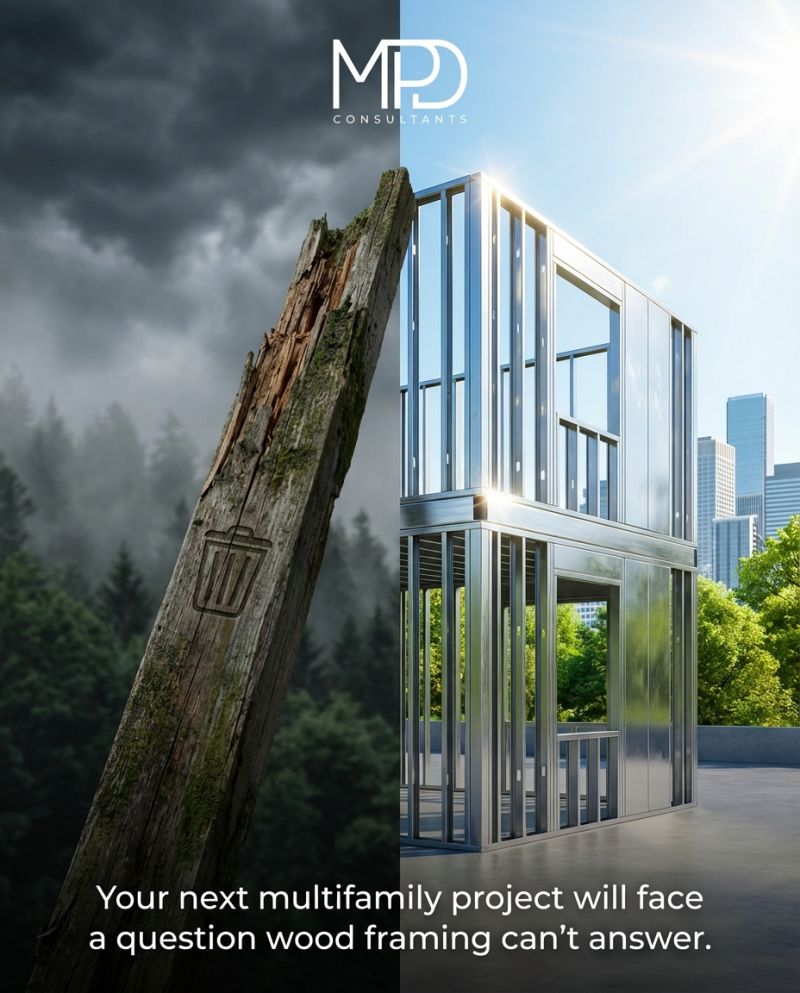
The Northeast United States faces an emerging crisis in multifamily housing construction. Wood-framed buildings—once the default choice for mid-rise residential projects—are proving increasingly dangerous, costly, and unreliable. This white paper examines the convergence of fire safety failures, insurance market disruption, and economic factors that make cold-formed steel (CFS) construction the superior alternative for projects of 5 stories and above.
Key findings: Recent catastrophic fires including the November 2025 Olympia Place fire at UMass Amherst demonstrate wood construction's inherent vulnerability. Insurance premiums for wood-framed buildings have increased 200–400% since 2020, with some insurers refusing coverage entirely. CFS achieves cost parity with wood at 5 stories and saves $13–21/SF at 6–7 stories when code-required fire protection measures are factored in. Non-combustible CFS construction eliminates the fundamental fire risk that drives escalating insurance costs, construction delays, and resident displacement.
1. The Fire Crisis in Wood Frame Construction
1.1 Recent Catastrophic Fire Events
UMass Amherst Fire (November 2025)
In November 2025, a catastrophic fire destroyed the 5-story, 200-unit Olympia Place student housing complex at UMass Amherst, Massachusetts. The Type IIIA wood-framed building was nearing completion when fire swept through the structure, resulting in:
- Complete structural loss of the building
- $67 million in estimated damages
- Displacement of 600+ planned student residents
- 18–24 month construction restart timeline
- Significant insurance market implications for similar projects
National Pattern
- College Park, Maryland (2024): $39 million total loss at the Fuse 47 project
- Multiple incidents 2021–2023: Fire losses quadrupled, reaching $400M in 2023
- Construction-phase fires account for the majority of catastrophic wood frame losses
1.2 Inherent Fire Vulnerabilities of Wood Construction
Construction Phase Vulnerabilities
- No operational sprinkler systems during framing
- Incomplete fire stopping and blocking
- Exposed wood fuel load at maximum during framing
- No building envelope to contain fire spread
- Hot work (cutting, welding) near exposed wood
- Limited access for fire department apparatus during construction
2. Insurance and Financial Impact
2.1 Insurance Premium Differentials
| Coverage Type | Wood Frame Premium | CFS Frame Premium | Differential |
|---|---|---|---|
| Builder's Risk | $8–12 per $1,000 value | $3–5 per $1,000 value | 60–65% lower for CFS |
| Property Insurance | $0.85–1.25 per $100 value | $0.35–0.55 per $100 value | 55–60% lower for CFS |
| Liability Coverage | Higher based on fire history | Lower based on material | 25–40% lower for CFS |
| Umbrella/Excess | $15,000–25,000 annual | $8,000–15,000 annual | 35–45% lower for CFS |
2.2 Risk Assessment Factors
Insurance underwriters evaluate multifamily construction risk based on ISO Construction Classification codes:
- ISO Class 1 (Frame): Wood frame construction — highest premium category
- ISO Class 4 (Masonry Non-Combustible): CFS with masonry veneer — significantly lower premiums
- ISO Class 5 (Modified Fire Resistive): CFS with rated assemblies — lowest premium tier for mid-rise
2.3 Quantified Financial Impact
For a typical 120-unit, 5-story multifamily project valued at $22 million:
| Cost Category | Wood Frame | CFS Frame | Savings with CFS |
|---|---|---|---|
| Builder's Risk (18 months) | $176,000–264,000 | $66,000–110,000 | $110,000–154,000 |
| Annual Property Insurance | $187,000–275,000 | $77,000–121,000 | $110,000–154,000 |
| 30-Year Insurance Cost | $5.6M–8.25M | $2.3M–3.6M | $3.3M–4.65M |
Insurance premium differential provides $110,000–154,000 annual savings, representing one of the most significant lifecycle cost advantages of CFS construction.
3. Building Code Analysis: The 5-Story Inflection Point
3.1 IBC Construction Types and CFS Applicability
| Construction Type | Fire Rating | Max Stories* | CFS Application |
|---|---|---|---|
| IA | 3-hr (non-combustible) | Unlimited | Requires concrete/steel primary |
| IB | 2-hr (non-combustible) | Unlimited | CFS with rated assemblies |
| IIA | 1-hr (non-combustible) | 5 stories | Full CFS bearing wall |
| IIB | 0-hr (non-combustible) | 5 stories | Full CFS bearing wall |
| IIIA | 1-hr (exterior non-comb) | 5 stories | Wood interior allowed |
| IIIB | 0-hr (exterior non-comb) | 5 stories | Wood interior allowed |
| VA | 1-hr (combustible) | 4 stories | N/A (wood construction) |
| VB | 0-hr (combustible) | 4 stories | N/A (wood construction) |
*Sprinklered buildings per IBC Table 504.4
3.2 Cost Comparison by Building Height
| Building Height | Wood Framing Cost/SF | CFS Framing Cost/SF | Winner | Differential |
|---|---|---|---|---|
| 4 Stories (Type VB) | $14.50–16.50 | $24.00–26.00 | Wood | +$8–10/SF for CFS |
| 5 Stories (Type IIIB) | $23.50–29.50 | $24.50–26.50 | Parity | ~$2–3/SF |
| 6 Stories (Type IIIA) | $38.00–42.00 | $24.50–28.50 | CFS | −$13.42/SF for CFS |
| 7 Stories | $46.00–52.00 | $25.00–31.00 | CFS | −$21.11/SF for CFS |
3.3 Why Wood Costs Escalate Above 4 Stories
Fire-Retardant Treated (FRT) Lumber Requirements
- 10–25% structural capacity reduction requiring upsized members
- Stainless steel fasteners required (+$0.25–0.40/SF)
- 6–12 week lead times
- Special inspection costs (+$3,000–5,000 per project)
Podium Construction (IBC 510.2)
Adds $12–15/SF and 8–12 weeks to project schedule for Type IA concrete podium below wood tower.
Example: For a 60,000 SF 6-story building, FRT lumber requirements alone add $294,000–$465,000 while CFS remains at standard specification.
3.4 Massachusetts 780 CMR Specific Considerations
- High-Rise Threshold: 70 feet (Massachusetts) vs. 75 feet (IBC standard) — measured from grade plane to highest occupied floor
- Cost Impact: Exceeding 70-foot threshold triggers $600,000–$1,300,000 in additional fire protection requirements
- Energy Code: Steel frame walls require R-13 + R-7.5 continuous insulation per 225 CMR 23
4. Cold-Formed Steel: The Non-Combustible Solution
4.1 Material Properties and Fire Performance
- Non-Combustible Classification: CFS contains no organic materials; classified non-combustible per IBC Section 703.4
- Melting Point: Steel melts at approximately 2,700°F (1,482°C), far exceeding typical building fire temperatures of 1,500–1,800°F
- Zero Flame Spread: CFS has zero flame spread rating and produces no smoke contribution
- No Fire Load Contribution: Does not add to the building's fire load — unlike wood which serves as fuel
4.2 Fire Resistance Ratings
| Fire Rating | Configuration | Typical Application |
|---|---|---|
| 60 minutes (1-hour) | Single layer Type X gypsum board | Dwelling unit separations, corridor walls |
| 90 minutes | Enhanced gypsum board configurations | Shaft enclosures, exit stair enclosures |
| 120 minutes (2-hour) | Double-layer Type X gypsum with fire-rated insulation | Occupancy separations, area firewalls |
| 180 minutes (3-hour) | UL G602 assembly with STRUCTO-CRETE | Parking/residential separations per IBC 406.6.1 |
4.3 Construction Phase Safety Advantages
- Non-combustible framing eliminates major fuel source even before sprinklers are operational
- Prefabrication reduces on-site cutting, welding, and hot work
- Minimal combustible materials during construction phase
- Steel framing maintains structural integrity even if fire occurs before completion
5. Additional CFS Construction Advantages
5.1 Dimensional Stability and Durability
Steel maintains fabricated dimensions throughout building service life with negligible moisture-related dimensional change. The coefficient of thermal expansion for steel (6.5 × 10⁻⁶ in/in/°F) produces predictable and minimal seasonal movement compared to wood dimensional lumber, which experiences cross-grain shrinkage of 3–8% as moisture content equilibrates.
This dimensional stability eliminates common wood-framed issues including:
- Floor squeaks from joist shrinkage and fastener loosening
- Drywall cracking at wall-to-ceiling interfaces due to truss uplift
- Door and window frame racking from wall plate shrinkage
- Trim gaps and flooring separations from differential movement
5.2 Biological Resistance
As an inorganic material, galvanized steel (G60 or G90 zinc coating per ASTM A653) is immune to biological degradation:
- Fungal Decay: No susceptibility to wood-destroying fungi
- Insect Damage: Eliminates termite damage risk
- Mold Growth: Does not support mold growth or experience strength loss from moisture exposure
5.3 Schedule and Labor Advantages
| Performance Metric | Wood Framing Baseline | CFS Panelized Performance | Improvement |
|---|---|---|---|
| Framing Schedule Duration | 8–12 weeks | 4–7 weeks | 35–45% reduction |
| Installation Labor Hours | 6–8 hrs per 100 SF wall | 2.5–4 hrs per 100 SF wall | 40–55% reduction |
| Material Waste Factor | 15–25% jobsite waste | 3–5% waste | 75–85% waste reduction |
| Weather Sensitivity | High — moisture damage risk | Low — weather independent | Reduced schedule risk |
5.4 Sustainability Benefits
- Recycled Content: 25–95% recycled content depending on production method
- End-of-Life Recovery: 100% recyclable at building demolition
- LEED Credits: Supports multiple LEED credit categories
6. Recommendations and Conclusions
6.1 Summary of Findings
- Fire Safety: Non-combustible CFS construction eliminates the fundamental fire vulnerability
- Economic Advantage: CFS achieves cost parity with wood at 5 stories and provides $13–21/SF savings at 6–7 stories
- Insurance Benefits: 35–75% premium reductions for builder's risk and property insurance
- Schedule Certainty: 30–50% framing schedule compression and weather independence
- Long-Term Value: Dimensional stability, biological resistance, and reduced maintenance
6.2 Recommendations for Development Teams
- Engage CFS-experienced structural engineers early in schematic design
- Request insurance quotes for both wood and CFS construction
- Evaluate total project cost including FRT lumber, podium requirements, and schedule impacts
- Consider panelized CFS systems for maximum schedule compression
- Factor lifecycle costs including maintenance, insurance, and residual value
7. References and Standards
7.1 Building Codes and Standards
- IBC 2021 (International Building Code)
- Massachusetts 780 CMR (10th Edition)
- AISI S100 — North American Specification for the Design of Cold-Formed Steel Structural Members
- AISI S240 — North American Standard for Cold-Formed Steel Structural Framing
- ASCE 7-22 — Minimum Design Loads and Associated Criteria for Buildings
- NFPA 13 — Standard for the Installation of Sprinkler Systems
- ASTM E119 — Standard Test Methods for Fire Tests of Building Construction and Materials
- ASTM E136 — Standard Test Method for Assessing Combustibility of Materials
7.2 UL Fire-Rated Assemblies
- UL G602 — 3-Hour Floor-Ceiling Assembly
- UL H505/H514 — Fire-Rated CFS Wall Assemblies
- UL L541 — Fire-Rated CFS Floor Assembly
- UL D902/D925 — Wood Frame Comparison Assemblies
7.3 Industry Resources
- SFIA (Steel Framing Industry Association)
- CFSEI (Cold-Formed Steel Engineers Institute)
- BuildSteel
- AISI (American Iron and Steel Institute)
- RSMeans 2024 Construction Cost Data
7.4 Fire Incident Reports
- Amherst Fire Department Reports — November 2025
- NFPA Fire Incident Data Center
- ISO Fire Rating Classifications
About MP Design Consultants LLC
Professional structural engineering services specializing in cold-formed steel construction throughout New England. Over 30 years experience, PE licenses across six states. Affiliated with AAC Steel, operating CFS panel fabrication in Franklin, MA and Woonsocket, RI.
Contact: Carlos Ferreira, PE, Principal
© 2026 MP Design Consultants LLC. All rights reserved.
Tags: Cold-Formed Steel, Wood vs Steel, Framing Comparison, Structural Performance, Fire Resistance, Dimensional Stability, Cost Comparison, Durability, Multifamily Construction